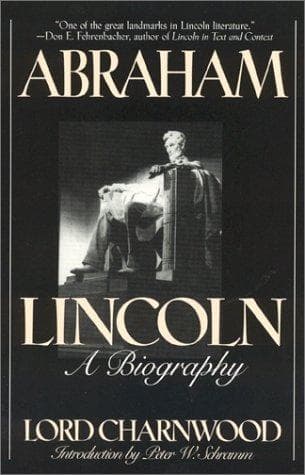
Abraham LincolnCharnwood, Godfrey Rathbone Benson, Baron
History
Abraham Lincoln
Charnwood, Godfrey Rathbone Benson, Baron
Lincoln, Abraham, 1809-1865; Presidents -- United States -- Biography
It is impossible to estimate how far Lincoln foresaw the strain to
which a firm stand against slavery would subject the Union. It is
likely enough that those worst forebodings for the Union, which events
proved to be very true, were confined to timid men who made a practice
of yielding to threats. Lincoln appreciated better than many of his
fellows the sentiment of the South, but it is often hard for men, not
in immediate contact with a school of thought which seems to them
thoroughly perverse, to appreciate its pervasive power, and Lincoln was
inclined to stake much upon the hope that reason will prevail.
Moreover, he had a confidence in the strength of the Union which might
have been justified if his predecessor in office had been a man of
ordinary firmness. But it is not to be supposed that any undue
hopefulness, if he felt it, influenced his judgment. He was of a
temper which does not seek to forecast what the future has to show, and
his melancholy prepared him well for any evil that might come. Two
things we can say with certainty of his aim and purpose. On the one
hand, as has already been said, whatever view he had taken of the peril
to the Union he would never have sought to avoid the peril by what
appeared to him a surrender of the principle which gave the Union its
worth. On the other hand, he must always have been prepared to uphold
the Union at whatever the cost might prove to be. To a man of deep and
gentle nature war will always be hateful, but it can never, any more
than an individual death, appear the worst of evils. And the claim of
the Southern States to separate from a community which to him was
venerable and to form a new nation, based on slavery and bound to live
in discord with its neighbors, did not appeal to him at all, though in
a certain literal sense it was a claim to liberty. His attitude to any
possible movement for secession was defined four years at least before
secession came, in words such as it was not his habit to use without
full sense of their possible effect or without much previous thought.
They were quite simple: "We won't break up the Union, and you shan't."
Public-domain text, read in full here on John Shaqi.
Reviews
Reviews
No reviews yet
Be the first to share your thoughts on this work.
Elsewhere in the archive
Join the Discussion
Join the discussion
Sign in to leave a comment or review.
Sign InorCreate an account