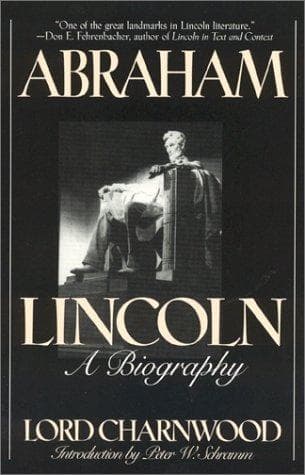
Abraham LincolnCharnwood, Godfrey Rathbone Benson, Baron
History
Abraham Lincoln
Charnwood, Godfrey Rathbone Benson, Baron
Lincoln, Abraham, 1809-1865; Presidents -- United States -- Biography
too, though an unscrupulous, was not, we may guess, an ungenerous man.
But the main fact of the matter is that Lincoln would have turned
traitor to his rooted convictions if he had not stood up and fought
Douglas even at this moment when Douglas was deserving of some
sympathy. Douglas, it must be observed, had simply acted on his
principle that the question between slavery and freedom was to be
settled by local, popular choice; he claimed for the white men of
Kansas the fair opportunity of voting; given that, he persistently
declared, "I do not care whether slavery be voted up or voted down."
In Lincoln's settled opinion this moral attitude of indifference to the
wrongfulness of slavery, so long as respect was had to the liberties of
the privileged race, was, so to say, treason to the basic principle of
the American Commonwealth, a treason which had steadily been becoming
rife and upon which it was time to stamp.
There can be no doubt of his earnestness about this. But the
Republican leaders, honourably enough, regarded this as an unpractical
line to take, and indeed to the political historian this is the most
crucial question in American history. Nobody can say that civil war
would or would not have occurred if this or that had been done a little
differently, but Abraham Lincoln, at this crisis of his life, did, in
pursuance of his peculiarly cherished principle, forge at least a link
in the chain of events which actually precipitated the war. And he did
it knowing better than any other man that he was doing something of
great national importance, involving at least great national risk. Was
he pursuing his principles, moderate as they were in the original
conception, with fanaticism, or at the best preferring a solemn
consistency of theory to the conscientious handling of facts not
reducible to theory? As a question of practical statesmanship in the
largest sense, how did matters really stand in regard to slavery and to
the relations between South and North, and what was Lincoln's idea of
"putting slavery back where the fathers placed it" really worth?
Public-domain text, read in full here on John Shaqi.
Reviews
Reviews
No reviews yet
Be the first to share your thoughts on this work.
Elsewhere in the archive
Join the Discussion
Join the discussion
Sign in to leave a comment or review.
Sign InorCreate an account