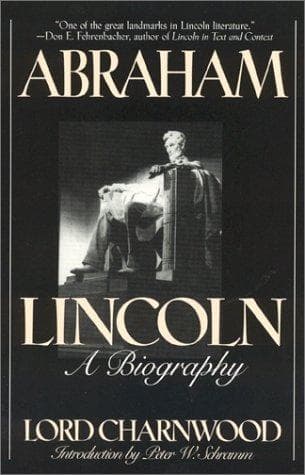
Abraham LincolnCharnwood, Godfrey Rathbone Benson, Baron
History
Abraham Lincoln
Charnwood, Godfrey Rathbone Benson, Baron
Lincoln, Abraham, 1809-1865; Presidents -- United States -- Biography
The first thing that must be grasped about it is the total difference of
view which now existed between North and South in regard to the very
nature of their connection. The divergence had taken place so completely
and in the main so quietly that each side now realised with surprise and
indignation that the other held an opposite opinion. In the North the
Union was regarded as constituting a permanent and unquestionable
national unity from which it was flat rebellion for a State or any other
combination of persons to secede. In the South the Union appeared merely
as a peculiarly venerable treaty of alliance, of which the dissolution
would be very painful, but which left each State a sovereign body with an
indefeasible right to secede if in the last resort it judged that the
painful necessity had come. In a few border States there was division
and doubt on this subject, a fact which must have helped to hide from
each side the true strength of opinion on the other. But, setting aside
these border States, there were in the North some who doubted whether it
was expedient to fight for the Union, but none of any consequence who
doubted that it was constitutionally correct; and there were in the South
men who insisted that no occasion to secede had arisen, but these very
men, when outvoted in their States, maintained most passionately the
absolute right of secession.
The two sides contended for two contrary doctrines of constitutional law.
It is natural when parties are disputing over a question of political
wisdom and of moral right that each should claim for its contention if
possible the sanction of acknowledged legal principle. So it was with
the parties to the English Civil War, and the tendency to regard matters
from a legal point of view is to this day deeply engrained in the mental
habits of America. But North and South were really divided by something
other than legal opinion, a difference in the objects to which their
feelings of loyalty and patriotism were directed. This difference found
apt expression in the Cabinet of President Buchanan, who of course
remained in office between the election of Lincoln in November and his
inauguration in March. General Cass of Michigan had formerly stood for
the Presidency with the support of the South, and he held Cabinet office
now as a sympathiser with the South upon slavery, but he was a
Northerner. "I see how it is," he said to two of his colleagues; "you
are a Virginian, and you are a South Carolinian; I am not a Michigander,
I am an American."
Public-domain text, read in full here on John Shaqi.
Reviews
Reviews
No reviews yet
Be the first to share your thoughts on this work.
Elsewhere in the archive
Join the Discussion
Join the discussion
Sign in to leave a comment or review.
Sign InorCreate an account