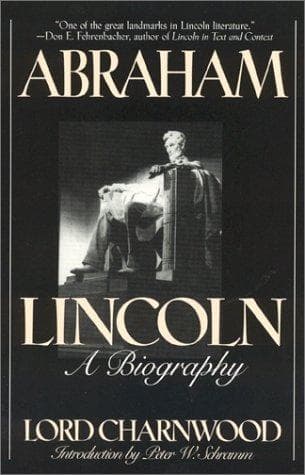
Abraham LincolnCharnwood, Godfrey Rathbone Benson, Baron
History
Abraham Lincoln
Charnwood, Godfrey Rathbone Benson, Baron
Lincoln, Abraham, 1809-1865; Presidents -- United States -- Biography
Up to Lincoln's inauguration the story of the Charleston forts, of which
one, lying on an island in the mouth of the harbour, was the famous Fort
Sumter, is briefly this. Buchanan was early informed that if the Union
Government desired to hold them, troops and ships of war should instantly
be sent. Congressmen from South Carolina remaining in Washington came to
him and represented that their State regarded these forts upon its soil
as their own; they gave assurances that there would be no attack on the
forts if the existing military situation was not altered, and they tried
to get a promise that the forts should not be reinforced. Buchanan would
give them no promise, but he equally refused the entreaties of Scott and
his own principal ministers that he should reinforce the forts, because
he declared that this would precipitate a conflict. Towards the end of
the year Major Anderson, not having men enough to hold all the forts if,
as he expected, they were attacked, withdrew his whole force to Fort
Sumter, which he thought the most defensible, dismantling the principal
other fort. The Governor of South Carolina protested against this as a
violation of a supposed understanding with the President, and seized upon
the United States arsenal and the custom house, taking the revenue
officers into State service. Commissioners had previously gone from
South Carolina to Washington to request the surrender of the forts, upon
terms of payment for property; they now declared that Anderson's
withdrawal, as putting him in a better position for defence, was an act
of war, and demanded that he should be ordered to retire to the mainland.
Buchanan wavered; decided to yield to them on this last point;
ultimately, on the last day of 1860, yielded instead to severe pressure
from Black, and decided to reinforce Anderson on Fort Sumter. The actual
attempt to reinforce him was bungled; a transport sent for this purpose
was fired upon by the South Carolina forces, and returned idle. This
first act of war, for some curious reason, caused no excitement. The
people of the North were intensely relieved that Buchanan had not yielded
to whatever South Carolina might demand, and, being prone to forgive and
to applaud, seem for a time to have experienced a thrill of glory in the
thought that the national administration had a mind. Dix, the Secretary
of the Treasury, elated them yet further by telegraphing to a Treasury
official at New Orleans, "If any one attempts to haul down the American
flag, shoot him on the spot." But Anderson remained without
reinforcements or further provisions when Lincoln entered office; and
troops in the service first of South Carolina and afterwards of the
Southern Confederacy, which was formed in February, erected batteries and
prepared to bombard Fort Sumter.
Public-domain text, read in full here on John Shaqi.
Reviews
Reviews
No reviews yet
Be the first to share your thoughts on this work.
Elsewhere in the archive
Join the Discussion
Join the discussion
Sign in to leave a comment or review.
Sign InorCreate an account