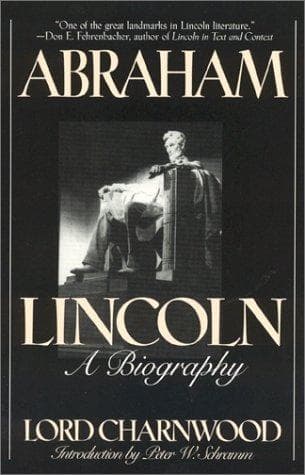
Abraham LincolnCharnwood, Godfrey Rathbone Benson, Baron
History
Abraham Lincoln
Charnwood, Godfrey Rathbone Benson, Baron
Lincoln, Abraham, 1809-1865; Presidents -- United States -- Biography
Union existed in any man's heart there were months of debate in which it
found no organised and hardly any audible expression. The most notable
stand against actual secession was that which was made in Georgia by
Stephens; he was determined and outspoken, but he proceeded wholly upon
the ground that secession was premature. And this instance is
significant of something further. It has been said that discussion and
voting were not free, and it would be altogether unlikely that their
freedom should in no cases be infringed, but there is no evidence that
this charge was widely true. It is surely significant of the general
temper of the South, and most honourable to it, that Stephens, who thus
struggled against secession at that moment, was chosen Vice-President of
the Southern Confederacy.
By February 4, 1861, the States of Mississippi, Florida, Alabama,
Georgia, and Louisiana had followed South Carolina by passing Ordinances
of Secession, and on that date representatives of these States met at
Montgomery in Alabama to found a new Confederacy. Texas, where
considerable resistance was offered by Governor Houston, the adventurous
leader under whom that State had separated from Mexico, was in process of
passing the like Ordinance. Virginia and North Carolina, which lie north
of the region where cotton prevails, and with them their western
neighbour Tennessee, and Arkansas, yet further west and separated from
Tennessee by the Mississippi River, did not secede till after Lincoln's
inauguration and the outbreak of war. But the position of Virginia
(except for its western districts) admitted of very little doubt, and
that of Tennessee and North Carolina was known to be much the same.
Virginia took a historic pride in the Union, and its interest in slavery
was not quite the same as that of the cotton States, yet its strongest
social ties were to the South. This State was now engaged in a last idle
attempt to keep itself and other border States in the Union, with some
hope also that the departed States might return; and on this same
February 6, a "Peace Convention," invited by Virginia and attended by
delegates from twenty-one States, met at Washington with ex-President
Tyler in the chair; but for Virginia it was all along a condition of any
terms of agreement that the right of any State to secede should be fully
acknowledged.
Public-domain text, read in full here on John Shaqi.
Reviews
Reviews
No reviews yet
Be the first to share your thoughts on this work.
Elsewhere in the archive
Join the Discussion
Join the discussion
Sign in to leave a comment or review.
Sign InorCreate an account