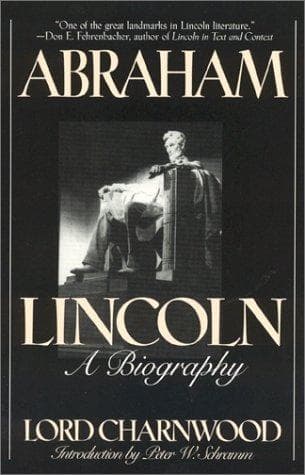
Abraham LincolnCharnwood, Godfrey Rathbone Benson, Baron
History
Abraham Lincoln
Charnwood, Godfrey Rathbone Benson, Baron
Lincoln, Abraham, 1809-1865; Presidents -- United States -- Biography
Indiana as Secretary of the Interior, Gideon Welles of Connecticut as
Secretary of the Navy, and Montgomery Blair of Maryland as
Postmaster-General. Welles, with the guidance of a brilliant
subordinate, Fox, served usefully, was very loyal to Lincoln, had an
antipathy to England which was dangerous, and kept very diligently a
diary for which we may be grateful now. Blair was a vehement,
irresponsible person with an influential connection, and, which was
important, his influence and that of his family lay in Maryland and other
border slave States. Of all these men, Seward, Secretary of State--that
is, Foreign Minister and something more--and Chase, Secretary of the
Treasury, most concern us. Lincoln's offer to Seward was made and
accepted in terms that did credit to both men, and Seward, still smarting
at his own defeat, was admirably loyal. But his friends, though they had
secured the appointment of Cameron to support them, thought increasingly
ill of the prospects of a Cabinet which included the Radical Chase. On
the very night before his inauguration Lincoln received from Seward, who
had just been helping to revise his Inaugural Address, a letter
withdrawing his acceptance of office. By some not clearly recorded
exercise of that great power over men, which, if with some failures, was
generally at his command, he forced Seward to see that the unconditional
withdrawal of this letter was his public duty. It must throughout what
follows be remembered that Lincoln's first and most constant duty was to
hold together the jarring elements in the North which these jarring
elements in his own Cabinet represented; and it was one of his great
achievements that he kept together, for as long as was needful, able but
discordant public servants who could never have combined together without
him.
On February 11, 1861, Lincoln, standing on the gallery at the end of a
railway car, upon the instant of departure from the home to which he
never returned, said to his old neighbours (according to the version of
his speech which his private secretary got him to dictate immediately
after): "My friends, no one, not in my situation, can appreciate my
feeling of sadness at this parting. To this place, and the kindness of
these people, I owe everything. Here I have lived for a quarter of a
century, and have passed from a young to an old man. Here my children
have been born and one is buried. I now leave, not knowing when or
whether ever I may return, with a task before me greater than that which
rested upon Washington. Without the assistance of that Divine Being who
ever attended him, I cannot succeed. With that assistance, I cannot
fail. Trusting in Him who can go with me, and remain with you, and be
everywhere for good, let us confidently hope that all will yet be well.
To His care commending you, as I hope in your prayers you will commend
me, I bid you an affectionate farewell."
Public-domain text, read in full here on John Shaqi.
Reviews
Reviews
No reviews yet
Be the first to share your thoughts on this work.
Elsewhere in the archive
Join the Discussion
Join the discussion
Sign in to leave a comment or review.
Sign InorCreate an account