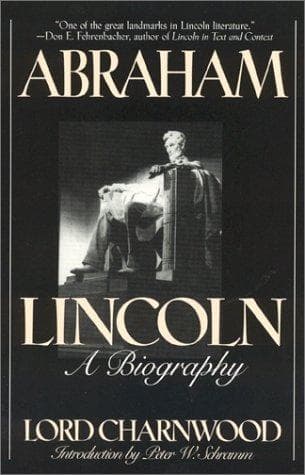
Abraham LincolnCharnwood, Godfrey Rathbone Benson, Baron
History
Abraham Lincoln
Charnwood, Godfrey Rathbone Benson, Baron
Lincoln, Abraham, 1809-1865; Presidents -- United States -- Biography
On March 4, 1861, old Buchanan came in his carriage to escort his
successor to the inaugural ceremony, where it was the ironical fate of
Chief Justice Taney to administer the oath to a President who had already
gone far to undo his great work. Yet a third notable Democrat was there
to do a pleasant little act. Douglas, Lincoln's defeated rival, placed
himself with a fine ostentation by his side, and, observing that he was
embarrassed as to where to put his new tall hat and preposterous
gold-knobbed cane, took charge of these encumbrances before the moment
arrived for the most eagerly awaited of all his speeches. Lincoln had
submitted his draft of his "First Inaugural" to Seward, and this draft
with Seward's abundant suggestions of amendment has been preserved. It
has considerable literary interest, and, by the readiness with which most
of Seward's suggestions were adopted, and the decision with which some,
and those not the least important, were set aside by Lincoln, it
illustrates well the working relation which, after one short struggle,
was to be established between these two men. By Seward's advice Lincoln
added to an otherwise dry speech some concluding paragraphs of emotional
appeal. The last sentence of the speech, which alone is much remembered,
is Seward's in the first conception of it, Seward's in the slightly
hackneyed phrase with which it ends, Lincoln's alone in the touch of
haunting beauty which is on it.
His "First Inaugural" was by general confession an able state paper,
setting forth simply and well a situation with which we are now familiar.
It sets out dispassionately the state of the controversy on slavery, lays
down with brief argument the position that the Union is indissoluble, and
proceeds to define the duty of the Government in face of an attempt to
dissolve it. "The power," he said, "confided to me will be used to hold,
occupy, and possess the property and places belonging to the Government,
and to collect the duties on imports; but beyond what may be necessary
for these objects there will be no invasion, no using of force against or
among the people anywhere. The mails, unless repelled, will continue to
be furnished in all parts of the Union." He proceeded to set out what he
conceived to be the impossibility of real separation; the intimate
relations between the peoples of the several States must still continue;
they would still remain for adjustment after any length of warfare; they
could be far better adjusted in Union than in enmity. He concluded: "In
your hands, my dissatisfied fellow-countrymen, and not in mine, is the
momentous issue of civil war. The Government will not assail you. You
can have no conflict without being yourselves the aggressors. I am loath
to close. We are not enemies but friends. We must not be enemies.
Though passion may have strained, it must not break our bonds of
affection. The mystic chords of memory, stretching from every
Public-domain text, read in full here on John Shaqi.
Reviews
Reviews
No reviews yet
Be the first to share your thoughts on this work.
Elsewhere in the archive
Join the Discussion
Join the discussion
Sign in to leave a comment or review.
Sign InorCreate an account