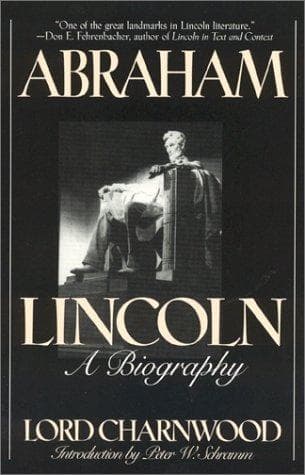
Abraham LincolnCharnwood, Godfrey Rathbone Benson, Baron
History
Abraham Lincoln
Charnwood, Godfrey Rathbone Benson, Baron
Lincoln, Abraham, 1809-1865; Presidents -- United States -- Biography
Lincoln was thus in a stronger position when he finally decided as to
Fort Sumter. It is unnecessary to follow the repeated consultations that
took place. There were preparations for possible expeditions both to
Fort Sumter and to Fort Pickens, and various blunders about them, and
Seward made some trouble by officious interference about them. An
announcement was sent to the Governor of South Carolina that provisions
would be sent to Fort Sumter and he was assured that if this was
unopposed no further steps would be taken. What chiefly concerns us is
that the eventual decision to send provisions but not troops to Fort
Sumter was Lincoln's decision; but that it was not taken till after
Senators and Congressmen had made clear to him that Northern opinion
would support him. It was the right decision, for it conspicuously
avoided the appearance of provocation, while it upheld the right of the
Union; but it was taken perilously late, and the delay exposed the
Government to the risk of a great humiliation.
An Alabama gentleman had urged Jefferson Davis that the impending
struggle must not be delayed. "Unless," he said, "you sprinkle blood in
the face of the people of Alabama, they will be back in the old Union in
ten days." There is every reason to suppose that the gentleman's
statement as to the probable collapse of the South was mere rhetoric, but
it seems that his advice led to orders being sent to Beauregard to reduce
Fort Sumter. Beauregard sent a summons to Anderson; Anderson, now all
but starved out, replied that unless he received supplies or instructions
he would surrender on April 15. Whether by Beauregard's orders or
through some misunderstanding, the Confederate batteries opened fire on
Fort Sumter on April 12. Fort Sumter became untenable on the next day,
when the relief ships, which Anderson had been led to expect sooner, but
which could in no case really have helped him, were just appearing in the
offing. Anderson very properly capitulated. On Sunday, April 14, 1861,
he marched out with the honours of war. The Union flag had been fired
upon in earnest by the Confederates, and, leaving Virginia and the States
that went with it to join the Confederacy if they chose, the North sprang
to arms.
Public-domain text, read in full here on John Shaqi.
Reviews
Reviews
No reviews yet
Be the first to share your thoughts on this work.
Elsewhere in the archive
Join the Discussion
Join the discussion
Sign in to leave a comment or review.
Sign InorCreate an account