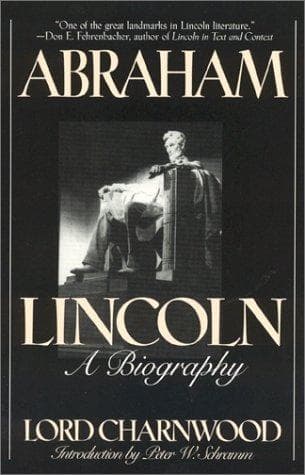
Abraham LincolnCharnwood, Godfrey Rathbone Benson, Baron
History
Abraham Lincoln
Charnwood, Godfrey Rathbone Benson, Baron
Lincoln, Abraham, 1809-1865; Presidents -- United States -- Biography
On the other hand, the South was in some respects very favourably
placed for resisting invasion from the North. The Southern forces
during most of the war were, in the language of military writers,
operating on interior lines; that is, the different portions of them
lay nearer to one another than did the different portions of the
Northern forces, and could be more quickly brought to converge on the
same point; the country abounded in strong positions for defence which
could be held by a relatively small force, while in every invading
movement the invaders had to advance long distances from the base, thus
exposing their lines of communication to attack. The advantage of this
situation, if competent use were made of it, was bound to go very far
towards compensating for inferiority of numbers; the North could not
make its superior numbers on land tell in any rapidly decisive fashion
without exposing itself to dangerous counter-strokes. In naval
strength its superiority was asserted almost from the first, and by
cutting off foreign supplies caused the Southern armies to suffer
severe privations before the war was half through; but its full effect
could only be produced very slowly. Thus, if its people were brave and
its leaders capable, the South was by no means in so hopeless a case as
might at first have appeared; with good fortune it might hope to strike
its powerful antagonist some deadly blow before that antagonist could
bring its strength to bear; and even if this hope failed, a
sufficiently tenacious defence might well wear down the patience of the
North.
As soldiers the Southerners started with a superiority which the
Northerners could only overtake slowly. If each people were taken in
the mass, the proportion of Southerners bred to an outdoor life was
higher. Generally speaking, if not exactly more frugal, they were far
less used to living comfortably. Above all, all classes of people
among them were still accustomed to think of fighting as a normal and
suitable occupation for a man; while the prevailing temper of the North
thought of man as meant for business, and its higher temper was apt to
think of fighting as odious and war out of date. This, like the other
advantages of the South, was transitory; before very long Northerners
who became soldiers at a sacrifice of inclination, from the highest
spirit of patriotism or in the methodic temper in which business has to
be done, would become man for man as good soldiers as the Southerners;
but the original superiority of the Southerners would continue to have
a moral effect in their own ranks and on the mind of the enemy, more
especially of the enemy's generals, even after its cause had ceased to
exist; and herein the military advantage of the South was undoubtedly,
through the first half of the war, considerable.
Public-domain text, read in full here on John Shaqi.
Reviews
Reviews
No reviews yet
Be the first to share your thoughts on this work.
Elsewhere in the archive
Join the Discussion
Join the discussion
Sign in to leave a comment or review.
Sign InorCreate an account