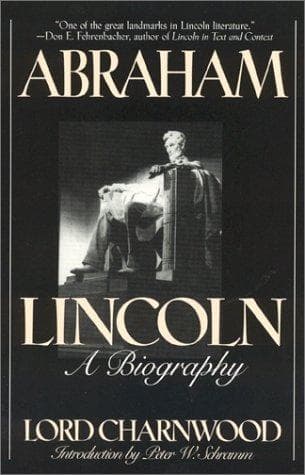
Abraham LincolnCharnwood, Godfrey Rathbone Benson, Baron
History
Abraham Lincoln
Charnwood, Godfrey Rathbone Benson, Baron
Lincoln, Abraham, 1809-1865; Presidents -- United States -- Biography
The introduction of compulsory service in the North has its place in
our subsequent story. The system that preceded it need not be dwelt
upon here, because, full of instruction as a technical study of it
(such as has been made by Colonel Henderson) must be, no brief survey
by an amateur could be useful. It is necessary, however, to understand
the position in which Lincoln's Administration was placed, without much
experience In America, or perhaps elsewhere in the world, to guide it.
It must not be contended, for it cannot be known that the problem was
fully and duly envisaged by Lincoln on his Cabinet, but it would
probably in any case have been impossible for them to pursue from the
first a consecutive and well-thought-out policy for raising an army and
keeping up its strength. The position of the North differed
fundamentally from that of the South; the North experienced neither the
ardour nor the throes of a revolution; it was never in any fear of
being conquered, only of not conquering. There was nothing, therefore,
which at once bestowed on the Government a moral power over the country
vastly in excess of that which it exercised in normal times. This,
however, was really necessary to it if the problem of the Army was to
be handled in the way which was desirable from a military point of
view. Compulsory service could not at first be thought of. It was
never supposed that the tiny regular Army of the United States
Government could be raised to any very great size by voluntary
enlistment, and the limited increase of it which was attempted was not
altogether successful. The existing militia system of the several
States was almost immediately found faulty and was discarded. A great
Volunteer Force had to be raised which should be under the command of
the President, who by the Constitution is Commander-in-Chief of the
forces of the Union, but which must be raised in each State by the
State Governor (or, if he was utterly wanting, by leading local
citizens). Now State Governors are not--it must be recalled--officers
under the President, but independent potentates acting usually in as
much detachment from him as the Vice-Chancellor of Oxford or Cambridge
from the Board of Education or a Presbyterian minister from a bishop.
This group of men, for the most part able, patriotic, and determined,
were there to be used and had to be consulted. It follows that the
policy of the North in raising and organising its armies had at first
to be a policy evolved between numerous independent authorities which
never met and were held together by a somewhat ignorant public opinion,
sometimes much depressed and sometimes, which was worse, oversanguine.
It is impossible to judge exactly how ill or how well Lincoln, under
such circumstances, grappled with this particular problem, but many
anomalies which seem to us preposterous--the raising of raw new
regiments when fine seasoned regiments were short of half their
Public-domain text, read in full here on John Shaqi.
Reviews
Reviews
No reviews yet
Be the first to share your thoughts on this work.
Elsewhere in the archive
Join the Discussion
Join the discussion
Sign in to leave a comment or review.
Sign InorCreate an account