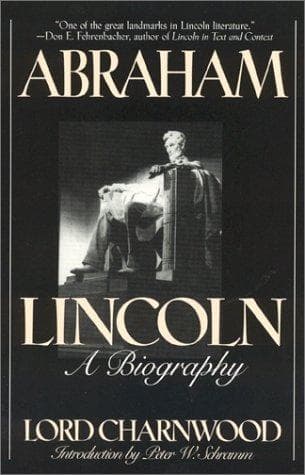
Abraham LincolnCharnwood, Godfrey Rathbone Benson, Baron
History
Abraham Lincoln
Charnwood, Godfrey Rathbone Benson, Baron
Lincoln, Abraham, 1809-1865; Presidents -- United States -- Biography
henceforth have to do with the Southern Confederacy and its armies, not
in their inner history but with sole regard to the task which they
imposed upon Lincoln and the North. But at this parting of the ways a
tribute is due to the two men, pre-eminent among many devoted people,
who, in their soldier-like and unreflecting loyalty to their cause,
gave to it a lustre in which, so far as they can be judged, neither its
statesmen nor its spiritual guides had a share.
There were Virginian officers who did not thus go with their State. Of
these were Scott himself, and G. H. Thomas; and Farragut, the great
sailor, was from Tennessee.
Throughout the free States of the North there took place a national
uprising of which none who remember it have spoken without feeling anew
its spontaneous ardour. Men flung off with delight the hesitancy of
the preceding months, and recruiting went on with speed and enthusiasm.
Party divisions for the moment disappeared. Old Buchanan made public
his adhesion to the Government. Douglas called upon Lincoln to ask how
best he could serve the public cause, and, at his request, went down to
Illinois to guide opinion and advance recruiting there; so employed,
the President's great rival, shortly after, fell ill and died, leaving
the leadership of the Democrats to be filled thereafter by more
scrupulous but less patriotic men. There was exultant confidence in
the power of the nation to put down rebellion, and those who realised
the peril in which for many days the capital and the administration
were placed were only the more indignantly determined. Perhaps the
most trustworthy record of popular emotions is to be found in popular
humorists. Shortly after these days Artemus Ward, the author who
almost vied with Shakespeare in Lincoln's affections, relates how the
confiscation of his show in the South led him to have an interview with
Jefferson Davis. "Even now," said Davis, in this pleasant fiction, "we
have many frens in the North." "J. Davis," is the reply, "there's your
grate mistaik. Many of us was your sincere frends, and thought certin
parties amung us was fussin' about you and meddlin' with your consarns
intirely too much. But, J. Davis, the minit you fire a gun at the
piece of dry goods called the Star-Spangled Banner, the North gits up
and rises en massy, in defence of that banner. Not agin you as
individooals--not agin the South even--but to save the flag. We should
indeed be weak in the knees, unsound in the heart, milk-white in the
liver, and soft in the hed, if we stood quietly by and saw this glorus
Govyment smashed to pieces, either by a furrin or a intestine foe. The
gentle-harted mother hates to take her naughty child across her knee,
but she knows it is her dooty to do it. So we shall hate to whip the
naughty South, but we must do it if you don't make back tracks at onct,
and we shall wallup you out of your boots!" In the days which
Public-domain text, read in full here on John Shaqi.
Reviews
Reviews
No reviews yet
Be the first to share your thoughts on this work.
Elsewhere in the archive
Join the Discussion
Join the discussion
Sign in to leave a comment or review.
Sign InorCreate an account