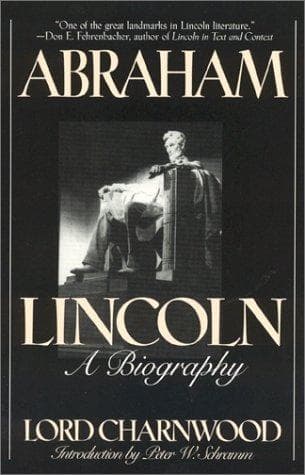
Abraham LincolnCharnwood, Godfrey Rathbone Benson, Baron
History
Abraham Lincoln
Charnwood, Godfrey Rathbone Benson, Baron
Lincoln, Abraham, 1809-1865; Presidents -- United States -- Biography
Before recounting this disaster we may proceed with the story of the
struggle in the border States. At an early date the rising armies of
the North had been organised into three commands, called the Department
of the Potomac, on the front between Washington and Richmond, the
Department of the Ohio, on the upper watershed of the river of that
name, and the Department of the West. Of necessity the generals
commanding in these two more Western Departments exercised a larger
discretion than the general at Washington. The Department of the Ohio
was under General McClellan, before the war a captain of Engineers, who
had retired from active service and had been engaged as a railway
manager, in which capacity he has already been noticed, but who had
earned a good name in the Mexican War, had been keen enough in his
profession to visit the Crimea, and was esteemed by General Scott. The
people of West Virginia, who, as has been said, were trying to organise
themselves as a new State, adhering to the Union, were invaded by
forces despatched by the Governor of their old State. They lay mainly
west of the mountains, and help could reach them up tributary valleys
of the Ohio. They appealed to McClellan, and the successes quickly won
by forces despatched by him, and afterwards under his direct command,
secured West Virginia, and incidentally the reputation of McClellan.
In Kentucky, further west, the Governor endeavoured to hold the field
for the South with a body known as the State Guard, while Unionist
leaders among the people were raising volunteer regiments for the
North. Nothing, however, was determined by fighting between these
forces. The State Legislature at first took up an attitude of
neutrality, but a new Legislature, elected in June, was overwhelmingly
for the Union. Ultimately the Confederate armies invaded Kentucky, and
the Legislature thereupon invited the Union armies into the State to
expel them, and placed 40,000 Kentucky volunteers at the disposal of
the President. Thenceforward, though Kentucky, stretching as it does
for four hundred miles between the Mississippi and the Alleghanies,
remained for long a battle-ground, the allegiance of its people to the
Union was unshaken. But the uncertainty about their attitude continued
till the autumn of 1861, and while it lasted was an important element
in Lincoln's calculations. (It must be remembered that slavery existed
in Kentucky, Maryland, and Missouri.) In Missouri the strife of
factions was fierce. Already in January there had been reports of a
conspiracy to seize the arsenal at St. Louis for the South when the
time came, and General Scott had placed in command Captain Nathaniel
Lyon, on whose loyalty he relied the more because he was an opponent of
slavery. The Governor was in favour of the South--as was also the
Legislature, and the Governor could count on some part of the State
Militia; so Lincoln, when he called for volunteers, commissioned Lyon
to raise them in Missouri.
Public-domain text, read in full here on John Shaqi.
Reviews
Reviews
No reviews yet
Be the first to share your thoughts on this work.
Elsewhere in the archive
Join the Discussion
Join the discussion
Sign in to leave a comment or review.
Sign InorCreate an account