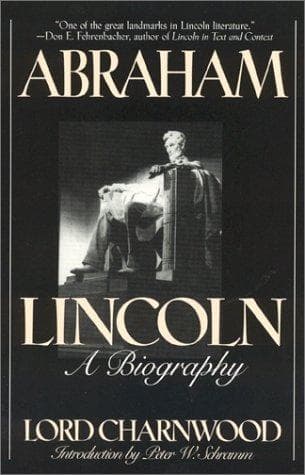
Abraham LincolnCharnwood, Godfrey Rathbone Benson, Baron
History
Abraham Lincoln
Charnwood, Godfrey Rathbone Benson, Baron
Lincoln, Abraham, 1809-1865; Presidents -- United States -- Biography
Neither the foreign policy of Lincoln's Government nor, indeed, the
relations of England and America from his day to our own can be
understood without some study of the attitude of the two countries to
each other during the war. If we could put aside any previous judgment
on the cause as between North and South, there are still some marked
features in the attitude of England during the war which every
Englishman must now regret. It should emphatically be added that there
were some upon which every Englishman should look back with
satisfaction. Many of the expressions of English opinion at that time
betray a powerlessness to comprehend another country and a
self-sufficiency in judging it, which, it may humbly be claimed, were
not always and are not now so characteristic of Englishmen as they were
in that period of our history, in many ways so noble, which we
associate with the rival influences of Palmerston and of Cobden. It is
not at all surprising that ordinary English gentlemen started with a
leaning towards the South; they liked Southerners and there was much in
the manners of the North, and in the experiences of Englishmen trading
with or investing in the North, which did not impress them favourably.
Many Northerners discovered something snobbish and unsound in this
preference, but they were not quite right. With this leaning,
Englishmen readily accepted the plea of the South that it was
threatened with intolerable interference; indeed to this day it is
hardly credible to Englishmen that the grievance against which the
South arose in such passionate revolt was so unsubstantial as it really
was. On the other hand, the case of the North was not apprehended.
How it came to pass, in the intricate and usually uninteresting play of
American politics, that a business community, which had seemed pretty
tolerant of slavery, was now at war on some point which was said to be
and said not to be slavery, was a little hard to understand. Those of
us who remember our parents' talk of the American Civil War did not
hear from them the true and fairly simple explanation of the war, that
the North fought because it refused to connive further in the extension
of slavery, and would not--could not decently--accept the disruption of
a great country as the alternative. It is strictly true that the
chivalrous South rose in blind passion for a cause at the bottom of
which lay the narrowest of pecuniary interests, while the over-sharp
Yankees, guided by a sort of comic backwoodsman, fought, whether wisely
or not, for a cause as untainted as ever animated a nation in arms.
But it seems a paradox even now, and there is no reproach in the fact,
that our fathers, who had not followed the vacillating course of
Northern politics hitherto, did not generally take it in. We shall see
in a later chapter how Northern statesmanship added to their
perplexity. But it is impossible not to be ashamed of some of the
Public-domain text, read in full here on John Shaqi.
Reviews
Reviews
No reviews yet
Be the first to share your thoughts on this work.
Elsewhere in the archive
Join the Discussion
Join the discussion
Sign in to leave a comment or review.
Sign InorCreate an account