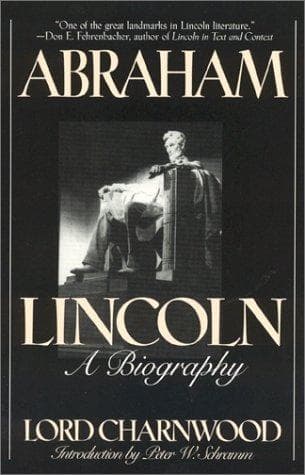
Abraham LincolnCharnwood, Godfrey Rathbone Benson, Baron
History
Abraham Lincoln
Charnwood, Godfrey Rathbone Benson, Baron
Lincoln, Abraham, 1809-1865; Presidents -- United States -- Biography
Each of the three generals, including the General-in-Chief, who was the
Government's chief adviser, was set upon his own immediate purpose, and
indisposed to understanding the situation of the others--Buell perhaps
the least so. Each of them had at first a very sound reason, the
unreadiness of his army, for being in no hurry to move, but then each
of them soon appeared to be a slow or unenterprising commander. Buell
was perhaps unlucky in this, for his whole conduct is the subject of
some controversy; but he did appear slow, and the two others, it is
universally agreed, really were so. As 1861 drew to a close, it became
urgent that something should be done somewhere, even if it were not
done in the best possible direction. The political pressure upon the
Administration became as great as before Bull Run. The army of the
Potomac had rapidly become a fine army, and its enemy, in no way
superior, lay entrenching at Manassas, twenty miles in front of it.
When Lincoln grew despondent and declared that "if something was not
done soon, the bottom would drop out of the whole concern," soldiers
remark that the military situation was really sound; but he was right,
for a people can hardly be kept up to the pitch of a high enterprise if
it is forced to think that nothing will happen. Before the end of the
year 1861 military reasons for waiting were no longer being urged;
McClellan had long been promising immediate action, Buell and Halleck
seemed merely unable to agree.
In later days when Lincoln had learnt much by experience it is hard to
trace the signs of his influence in military matters, because, though
he followed them closely, he was commonly in full agreement with his
chief general and he invariably and rightly left him free. At this
stage, when his position was more difficult, and his guidance came from
common sense and the military books, of which, ever since Bull Run, he
had been trying, amidst all his work, to tear out the heart, there is
evidence on which to judge the intelligence which he applied to the
war. Certainly he now and ever after looked at the matter as a whole
and formed a clear view of it, which, for a civilian at any rate, was a
reasonable view. Certainly also at this time and for long after no
military adviser attempted, in correcting any error of his, to supply
him with a better opinion equally clear and comprehensive. This is
probably why some Northern military critics, when they came to read his
correspondence with his generals, called him, as his chief biographers
were tempted to think him, "the ablest strategist of the war." Grant
and Sherman did not say this; they said, what is another thing, that
his was the greatest intellectual force that they had met with.
Strictly speaking, he could not be a strategist. If he were so judged,
he would certainly be found guilty of having, till Grant came to
Washington, unduly scattered his forces. He could pick out the main
Public-domain text, read in full here on John Shaqi.
Reviews
Reviews
No reviews yet
Be the first to share your thoughts on this work.
Elsewhere in the archive
Join the Discussion
Join the discussion
Sign in to leave a comment or review.
Sign InorCreate an account