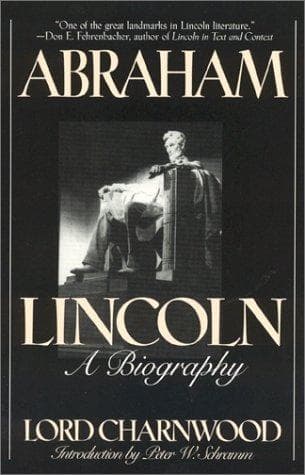
Abraham LincolnCharnwood, Godfrey Rathbone Benson, Baron
History
Abraham Lincoln
Charnwood, Godfrey Rathbone Benson, Baron
Lincoln, Abraham, 1809-1865; Presidents -- United States -- Biography
set on the right hand or the left according as they were of
irreproachable or reproachable character; they were divided into those
who did and those who did not. In the provisional judgment which men,
if they make it modestly, should at times make with decision,
McClellan's place is clear. The quality, "spiacente a Dio ed ai nemici
suoi," of the men who did not, ran through and through him.
Lincoln required first a general who would make no fatal blunder, but
he required too, when he could find him, a general of undaunted
enterprise; he did not wish to expose the North to disaster, but he did
mean to conquer the South. There was some security in employing
McClellan, though employing him did at one time throw on Lincoln's
unfit shoulders the task of defending Washington. It proved very hard
to find another general equally trustworthy. But, in the light of
facts which Lincoln came to perceive, it proved impossible to consider
McClellan as the man to finish the war.
We need only notice the doings of the main armies in this theatre of
the war and take no account of various minor affairs at outlying posts.
From the battle of Bull Run, which was on July 21, 1861, to March 5,
1862, the Southern army under Joseph Johnston lay quietly drilling at
Manassas. It, of course, entrenched its position, but to add to the
appearance of its strength, it constructed embrasures for more than its
number of guns and had dummy guns to show in them. At one moment there
was a prospect that it might move. Johnston and the general with him
had no idea of attacking the army of the Potomac where it lay, but they
did think that with a further 50,000 or 60,000 they might successfully
invade Maryland, crossing higher up the Potomac, and by drawing
McClellan away from his present position, get a chance of defeating
him. The Southern President came to Manassas, at their invitation, on
October 1, but he did not think well to withdraw the trained men whom
he could have sent to Johnston from the various points in the South at
which they were stationed; he may have had good reasons but it is
likely that he sacrificed one of the best chances of the South.
McClellan's army was soon in as good a state of preparation as
Johnston's. Early in October McClellan had, on his own statement, over
147,000 men at his disposal; Joseph Johnston, on his own statement,
under 47,000. Johnston was well informed as to McClellan's
numbers--very likely he could get information from Maryland more easily
than McClellan from Virginia. The two armies lay not twenty-five miles
apart. The weather and the roads were good to the end of December; the
roads were practicable by March and they seem to have been so all the
time. As spring approached, it appeared to the Southern generals that
McClellan must soon advance. Johnston thought that his right flank was
liable to be turned and the railway communications south of Manassas
liable to be cut. In the course of February it was realised that his
Public-domain text, read in full here on John Shaqi.
Reviews
Reviews
No reviews yet
Be the first to share your thoughts on this work.
Elsewhere in the archive
Join the Discussion
Join the discussion
Sign in to leave a comment or review.
Sign InorCreate an account