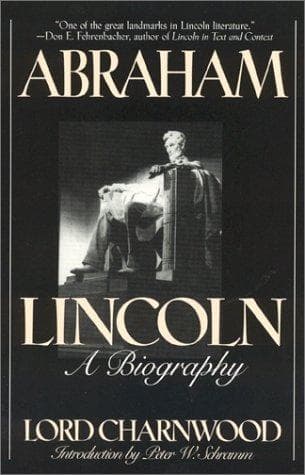
Abraham LincolnCharnwood, Godfrey Rathbone Benson, Baron
History
Abraham Lincoln
Charnwood, Godfrey Rathbone Benson, Baron
Lincoln, Abraham, 1809-1865; Presidents -- United States -- Biography
impose enfranchisement, possibly with no compensation, upon the States
that still delayed. The force of example and the presence of this fear
could not have been resisted long. Lincoln was not a man who could be
accused of taking any course without a reason well thought out; we can
safely conclude that in the summer of 1862 he nursed a hope, by no
means visionary, of initiating a process of liberation free from
certain evils in that upon which he was driven back.
Before, however, he had quite abandoned this hope he had already begun
to see his way in case it failed. His last appeal to the border States
was made on July 12, 1862, while McClellan's army still lay at
Harrison's Landing. On the following day he privately told Seward and
Bates that he had "about come to the conclusion that it was a military
necessity, absolutely essential to the salvation of the nation, that we
must free the slaves or be ourselves subdued." On July 22 he read to
his Cabinet the first draft of his Proclamation of Emancipation;
telling them before he consulted them that substantially his mind was
made up. Various members of the Cabinet raised points on which he had
already thought and had come to a conclusion, but, as he afterwards
told a friend, Seward raised a point which had never struck him before.
He said that, if issued at that time of depression, just after the
failure in the Peninsula, the Proclamation would seem like "a cry of
distress"; and that it would have a much better effect if it were
issued after some military success.
Seward was certainly right. The danger of division in the North would
have been increased and the prospect of a good effect abroad would have
been diminished if the Proclamation had been issued at a time of
depression and manifest failure. Lincoln, who had been set on issuing
it, instantly felt the force of this objection. He put aside his
draft, and resolved not to issue the Proclamation till the right
moment, and apparently resolved to keep the whole question open in his
own mind till the time for action came.
Public-domain text, read in full here on John Shaqi.
Reviews
Reviews
No reviews yet
Be the first to share your thoughts on this work.
Elsewhere in the archive
Join the Discussion
Join the discussion
Sign in to leave a comment or review.
Sign InorCreate an account