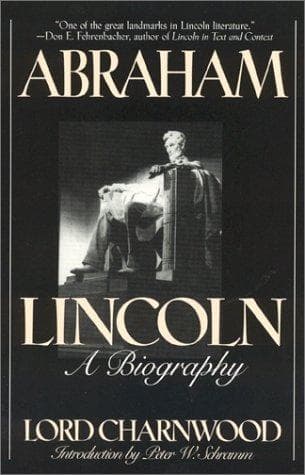
Abraham LincolnCharnwood, Godfrey Rathbone Benson, Baron
History
Abraham Lincoln
Charnwood, Godfrey Rathbone Benson, Baron
Lincoln, Abraham, 1809-1865; Presidents -- United States -- Biography
It may be well here, without waiting to trace further the course of the
war, in which at the point where we left it the slow but irresistible
progress of conquest was about to set in, to recount briefly the later
stages of the abolition of slavery in America. In 1863 it became
apparent that popular feeling in Missouri and in Maryland was getting
ripe for abolition. Bills were introduced into Congress to compensate
their States if they did away with slavery; the compensation was to be
larger if the abolition was immediate and not gradual. There was a
majority in each House for these Bills, but the Democratic minority was
able to kill them in the House of Representatives by the methods of
"filibustering," or, as we call it, obstruction, to which the procedure
of that body seems well adapted. The Republican majority had not been
very zealous for the Bills; its members asked "why compensate for a
wrong" which they had begun to feel would soon be abolished without
compensation; but their leaders at least did their best for the Bills.
It would have been idle after the failure of these proposals to
introduce the Bills that had been contemplated for buying out the loyal
slave owners in West Virginia, Kentucky, and Tennessee, which was now
fast being regained for the Union. Lincoln after his Message of
December, 1862, recognised it as useless for him to press again the
principles of gradual emancipation or of compensation, as to which it
is worth remembrance that the compensation which he proposed was for
loyal and disloyal owners alike. His Administration, however, bought
every suitable slave in Delaware for service (service as a free man) in
the Army. In the course of 1864 a remarkable development of public
opinion began to be manifest in the States chiefly concerned. In the
autumn of that year Maryland, whose representatives had paid so little
attention to Lincoln two years before, passed an Amendment to the State
Constitution abolishing slavery without compensation. A movement in
the same direction was felt to be making progress in Kentucky and
Tennessee; and Missouri followed Maryland's example in January, 1865.
Meanwhile, Louisiana had been reconquered, and the Unionists in these
States, constantly encouraged and protected by Lincoln when Congress
looked upon them somewhat coldly or his generals showed jealousy of
their action, had banded themselves together to form State Governments
with Constitutions that forbade slavery. Lincoln, it may be noted, had
suggested to Louisiana that it would be well to frame some plan by
which the best educated of the negroes should be admitted to the
franchise. Four years after his death a Constitutional Amendment was
passed by which any distinction as to franchise on the ground of race
or colour is forbidden in America. The policy of giving the vote to
negroes indiscriminately had commended itself to the cold pedantry of
some persons, including Chase, on the ground of some natural right of
Public-domain text, read in full here on John Shaqi.
Reviews
Reviews
No reviews yet
Be the first to share your thoughts on this work.
Elsewhere in the archive
Join the Discussion
Join the discussion
Sign in to leave a comment or review.
Sign InorCreate an account