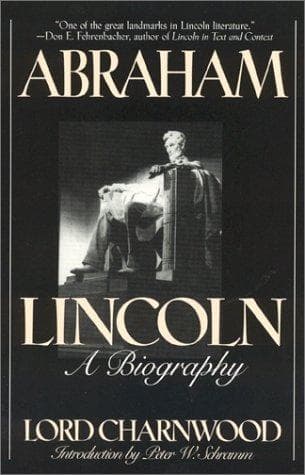
Abraham LincolnCharnwood, Godfrey Rathbone Benson, Baron
History
Abraham Lincoln
Charnwood, Godfrey Rathbone Benson, Baron
Lincoln, Abraham, 1809-1865; Presidents -- United States -- Biography
Neither side obtained the levies of men that it needed without resort to
compulsion. The South, in which this necessity either arose more quickly
or was seen more readily, had called up before the end of the war its
whole available manhood. In the North the proportion of effort and
sacrifice required was obviously less, and, at least at one critical
moment, it was disastrously under-estimated. A system of compulsion, to
be used in default of volunteering, was brought into effect half-way
through the war. Under this system there were in arms at the end of the
war 980,000 white Northern soldiers, who probably stood to the population
at that time in as high a proportion as 1 to 25, and everything was in
readiness for calling up a vastly greater number if necessary. After
twenty months of war, when the purely voluntary system still existed but
was proving itself inadequate to make good the wastage of the armies, the
number in arms for the North was 860,717, perhaps as much as 1 in 27 of
the population then. It would be useless to evade the question which at
once suggests itself, whether the results of voluntary enlistment in this
country during the present war have surpassed to the extent to which they
undoubtedly ought to have surpassed the standard set by the North in the
Civil War. For these two cases furnish the only instances in which the
institution of voluntary enlistment has been submitted to a severe test
by Governments reluctant to abandon it. The two cases are of course not
strictly comparable. Our own country in this matter had the advantages
of riper organisation, political and social, and of the preparatory
education given it by the Territorials and by Lord Roberts. The
extremity of the need was in our case immediately apparent; and the cause
at issue appealed with the utmost simplicity and intensity to every brave
and to every gentle nature. In the Northern States, on the other hand,
apart from all other considerations, there were certain to be sections,
local, racial, and political, upon which the national cause could take no
very firm hold. That this was so proves no unusual prevalence of
selfishness or of stupidity; and the apathy of such sections of the
people, like that of smaller sections in our own case, sets in a brighter
light the devotion which made so many eager to give their all. Moreover,
the general patriotism of the Northern people is not to be judged by the
failure of the purely voluntary system, but rather, as will be seen
later, by the success of the system which succeeded it. There is in our
case no official statement of the exact number serving on any particular
day, but the facts which are published make it safe to conclude that, at
the end of fifteen months of war, when no compulsion was in force, the
soldiers then in service and drawn from the United Kingdom alone amounted
to 1 in 17 of the population. The population in this case is one of
Public-domain text, read in full here on John Shaqi.
Reviews
Reviews
No reviews yet
Be the first to share your thoughts on this work.
Elsewhere in the archive
Join the Discussion
Join the discussion
Sign in to leave a comment or review.
Sign InorCreate an account