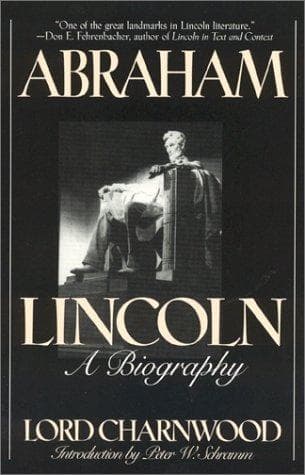
Abraham LincolnCharnwood, Godfrey Rathbone Benson, Baron
History
Abraham Lincoln
Charnwood, Godfrey Rathbone Benson, Baron
Lincoln, Abraham, 1809-1865; Presidents -- United States -- Biography
Rather unluckily, Lincoln, upon his rejection or release, relieved his
feelings in a letter about Miss Owens to one of the somewhat older
married ladies who were kind to him, the wife of one of his colleagues.
She ought to have burnt his letter, but she preserved it to kindle mild
gossip after his death. It is a burlesque account of his whole
adventure, describing, with touches of very bad taste, his
disillusionment with the now maturer charms of Miss Owens when her
sister brought her back to New Salem, and making comedy of his own
honest bewilderment and his mingled relief and mortification when she
at last refused him. We may take it as evidence of the natural want of
perception and right instinctive judgment in minor matters which some
who knew and loved him attribute to him. But, besides that, the man
who found relief in this ill-conceived exercise of humour was one in
whom the prospect of marriage caused some strange and pitiful
perturbation of mind.
This was in 1838, and a year later Mary Todd came from Kentucky to stay
at Springfield with her brother-in-law Ninian Edwards, a legislator of
Illinois and a close ally of Lincoln's. She was aged twenty-one, and
her weight was one hundred and thirty pounds. She was well educated,
and had family connections which were highly esteemed. She was
pleasant in company, but somewhat imperious, and she was a vivacious
talker. When among the young men who now became attentive in calling
on the Edwards's Lincoln came and sat awkwardly gazing on Miss Todd,
Mrs. Edwards appears to have remarked that the two were not suited to
each other. But an engagement took place all the same. As to the
details of what followed, whether he or she was the first to have
doubts, and whether, as some say, the great Stephen Douglas appeared on
the scene as a rival and withdrew rather generously but too late, is
uncertain. But Lincoln composed a letter to break off his engagement.
He showed it to Joshua Speed, who told him that if he had the courage
of a man he would not write to her, but see her and speak. He did so.
She cried. He kissed and tried to comfort her. After this Speed had
to point out to him that he had really renewed his engagement. Again
there may be some uncertainty whether on January 1, 1841, the bridal
party had actually assembled and the bridegroom after long search was
found by his friends wandering about in a state which made them watch
day and night and keep knives from him. But it is quite certain from
his letters that in some such way on "the fatal 1st of January, 1841,"
he broke down terribly. Some weeks later he wrote to his partner:
"Whether I shall ever be better I cannot tell; I awfully forebode I
shall not. To remain as I am is impossible. I must die or be better,
as it appears to me." After a while Speed was able to remove him to
his own parents' home in Kentucky, where he and his mother nursed him
back to mental life.
Public-domain text, read in full here on John Shaqi.
Reviews
Reviews
No reviews yet
Be the first to share your thoughts on this work.
Elsewhere in the archive
Join the Discussion
Join the discussion
Sign in to leave a comment or review.
Sign InorCreate an account