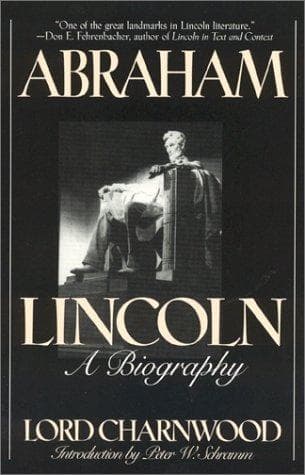
Abraham LincolnCharnwood, Godfrey Rathbone Benson, Baron
History
Abraham Lincoln
Charnwood, Godfrey Rathbone Benson, Baron
Lincoln, Abraham, 1809-1865; Presidents -- United States -- Biography
Then in the course of 1841 Speed himself began to contemplate marriage,
and Speed himself had painful searchings of heart, and Lincoln's turn
came to show a sureness of perception in his friend's case that he
wholly lacked in his own. "I know," he writes, "what the painful point
with you is . . . it is an apprehension that you do not love her as you
should. What nonsense! How came you to court her? But you say you
reasoned yourself into it. What do you mean by that? Was it not that
you found yourself unable to reason yourself out of it? Did you not
think, and partly form the purpose, of courting her the first time you
ever saw or heard of her? What had reason to do with it at that early
stage?" A little later the lady of Speed's love falls ill. Lincoln
writes: "I hope and believe that your present anxiety about her health
and her life must and will for ever banish those horrid doubts which I
know you sometimes felt as to the truth of your affection for
her. . . . Perhaps this point is no longer a question with you, and my
pertinacious dwelling upon it is a rude intrusion upon your feelings.
If so, you must pardon me. You know the hell I have suffered upon that
point, and how tender I am upon it." When he writes thus it is no
surprise to hear from him that he has lost his hypochondria, but it may
be that the keen recollection of it gives him excessive anxieties for
Speed. On the eve of the wedding he writes: "You will always hereafter
be on ground that I have never occupied, and consequently, if advice
were needed, I might advise wrong. I do fondly hope, however, that you
will never need comfort from abroad. I incline to think it probable
that your nerves will occasionally fail you for a while; but once you
get them firmly graded now, that trouble is over for ever. If you went
through the ceremony calmly or even with sufficient composure not to
excite alarm in any present, you are safe beyond question, and in two
or three months, to say the most, will be the happiest of men." Soon
he is reassured and can "feel somewhat jealous of both of you now. You
will be so exclusively concerned with one another that I shall be
forgotten entirely. I shall feel very lonesome without you." And a
little later: "It cannot be told how it thrills me with joy to hear you
say you are far happier than you ever expected to be. I know you too
well to suppose your expectations were not at least sometimes
extravagant, and if the reality exceeds them all, I say, 'Enough, dear
Lord.'" And here follows what might perhaps have been foreseen: "Your
last letter gave me more pleasure than the total sum of all that I have
received since the fatal 1st of January, 1841. Since then it seems to
me I should have been entirely happy but for the never absent idea that
there is still one unhappy whom I have contributed to make so. That
kills my soul. I cannot but reproach myself for even wishing to be
Public-domain text, read in full here on John Shaqi.
Reviews
Reviews
No reviews yet
Be the first to share your thoughts on this work.
Elsewhere in the archive
Join the Discussion
Join the discussion
Sign in to leave a comment or review.
Sign InorCreate an account