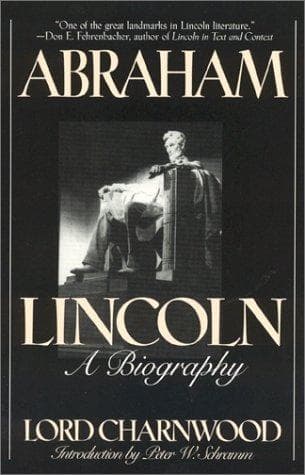
Abraham LincolnCharnwood, Godfrey Rathbone Benson, Baron
History
Abraham Lincoln
Charnwood, Godfrey Rathbone Benson, Baron
Lincoln, Abraham, 1809-1865; Presidents -- United States -- Biography
In some respects he let himself be. His exterior oddities never seem
to have toned down much; he could not be taught to introduce tidiness
or method into his office; nor did he make himself an exact lawyer; a
rough and ready familiarity with practice and a firm grasp of larger
principles of law contented him without any great apparatus of
learning. His method of study was as odd as anything else about him;
he could read hard and commit things to memory in the midst of bustle
and noise; on the other hand, since reading aloud was his chosen way of
impressing what he read on his own mind, he would do it at all sorts of
times to the sore distraction of his partner. When his studies are
spoken of, observation and thought on some plan concealed in his own
mind must be taken to have formed the largest element in these studies.
There was, however, one methodic discipline, highly commended of old
but seldom perhaps seriously pursued with the like object by men of
forty, even self-taught men, which he did pursue. Some time during
these years he mastered the first six Books of Euclid. It would
probably be no mere fancy if we were to trace certain definite effects
of this discipline upon his mind and character. The faculty which he
had before shown of reducing his thought on any subject to the simplest
and plainest terms possible, now grew so strong that few men can be
compared with him in this. He was gaining, too, from some source, what
the ancient geometers would themselves have claimed as partly the
product of their study: the plain fact and its plain consequences were
not only clear in calm hours of thought, but remained present to him,
felt and instinctive, through seasons of confusion, passion, and
dismay. His life in one sense was very full of companionship, but it
is probable that in his real intellectual interests he was lonely. To
Herndon, intelligently interested in many things, his master's mind,
much as he held it in awe, seemed chillingly unpoetic--which is a
curious view of a mind steeped in Shakespeare and Burns. The two
partners had been separately to Niagara. Herndon was anxious to know
what had been Lincoln's chief impression, and was pained by the reply,
"I wondered where all that water came from," which he felt showed
materialism and insensibility. Lincoln's thought had, very obviously,
a sort of poetry of its own, but of a vast and rather awful kind. He
had occasionally written verses of his own a little before this time;
sad verses about a friend who had become a lunatic, wondering that he
should be allowed to outlive his mind while happy young lives passed
away, and sad verses about a visit to old familiar fields in Indiana,
where he wandered brooding, as he says,
"Till every sound appears a knell,
And every spot a grave."
Public-domain text, read in full here on John Shaqi.
Reviews
Reviews
No reviews yet
Be the first to share your thoughts on this work.
Elsewhere in the archive
Join the Discussion
Join the discussion
Sign in to leave a comment or review.
Sign InorCreate an account