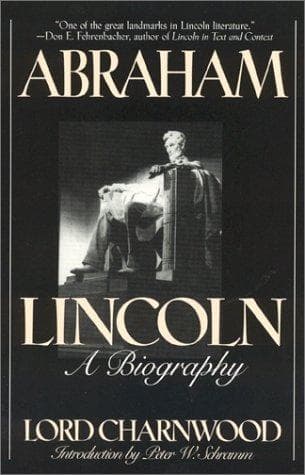
Abraham LincolnCharnwood, Godfrey Rathbone Benson, Baron
History
Abraham Lincoln
Charnwood, Godfrey Rathbone Benson, Baron
Lincoln, Abraham, 1809-1865; Presidents -- United States -- Biography
In the second place there was a revolution in the party system. The
old Whig party, which, whatever its tendencies, had avoided having any
principle in regard to slavery, now abruptly and opportunely expired.
There had been an attempt once before, and that time mainly among the
Democrats, to create a new "Free-soil Party," but it had come to very
little. This time a permanent fusion was accomplished between the
majority of the former Whigs in the North and a numerous secession from
among the Northern Democrats. They created the great Republican party,
of which the name and organisation have continued to this day, but of
which the original principle was simply and solely that there should be
no further extension of slavery upon territory present or future of the
United States. It naturally consisted of Northerners only. This was
of course an ominous fact, and caused people, who were too timid either
to join the Republicans or turn Democrat, to take refuge in another
strange party, formed about this time, which had no views about
slavery. This was the "American" party, commonly called the
"Know-Nothing" party from its ridiculous and objectionable secret
organisation. Its principle was dislike of foreign immigrants,
especially such as were Roman Catholics. To them ex-President
Fillmore, protesting against "the madness of the times" when men
ventured to say yes or no on a question relating to slavery, fled for
comfort, and became their candidate for the Presidency at the next
election.
It was in 1854 that Lincoln returned to political life as one of the
founders of the Republican party. But it will be better at once to
deal with one or two later events with which he was not specially
concerned. The Republicans chose as their Presidential candidate in
1856 an attractive figure, John Fremont, a Southerner of French origin,
who had conducted daring and successful explorations in Oregon, had
some hand (perhaps a very important hand) in conquering California from
Mexico, and played a prominent part in securing California for freedom.
The Southern Democrats again secured a Northern instrument in James
Buchanan of Pennsylvania, an elderly and very respectable man, who was
understood to be well versed in diplomatic and official life. He was a
more memorable personage than Pierce. A great chorus of friendly
witnesses to his character has united in ascribing all his actions to
weakness.
Public-domain text, read in full here on John Shaqi.
Reviews
Reviews
No reviews yet
Be the first to share your thoughts on this work.
Elsewhere in the archive
Join the Discussion
Join the discussion
Sign in to leave a comment or review.
Sign InorCreate an account