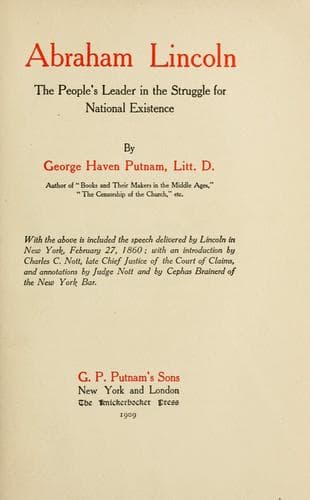
Abraham Lincoln: The People's Leader in the Struggle for National ExistencePutnam, George Haven
History
Abraham Lincoln: The People's Leader in the Struggle for National Existence
Putnam, George Haven
Lincoln, Abraham, 1809-1865; United States -- History -- Civil War, 1861-1865
First, that the compact entered into by the Fathers and by their
immediate successors should be loyally carried out, and that slavery
should not be interfered with in the original slave States, or in the
additional territory that had been conceded to it under the Missouri
Compromise; and, secondly, that not a single further square mile of
soil, that was still free, should be left available, or should be made
available, for the incursion of slavery.
It was the conviction of Lincoln and of his associates, as it had been
the conviction of the Fathers, that under such a restriction slavery
must certainly in the near future come to an end. It was because these
convictions, both in the debates with Douglas and in the Cooper
Institute speech, were presented by Lincoln more forcibly and more
conclusively than had been done by any other political leader, that
Lincoln secured the nomination and the presidency. The February address
was assuredly a deciding factor in the great issue of the time, and it
certainly belongs, therefore, with the historic documents of the
republic.
G.H.P.
NEW YORK, September 1, 1909.
CORRESPONDENCE WITH LINCOLN, NOTT, AND BRAINERD
(_From Robert Lincoln_)
MANCHESTER, VERMONT,
July 27, 1909.
DEAR MAJOR PUTNAM:
Your letter of July 23rd reaches me here, and I beg to express my
thanks for your kind remembrances of me in London.... I am much
interested in learning that you were present at the time my father
made his speech at Cooper Institute. I, of course, remember the
occasion very well, although I was not present. I was at that time
in the middle of my year at Phillips Exeter Academy, preparing for
the Harvard entrance examination of the summer of 1860.... After the
Cooper Institute address, my father came to Exeter to see how I was
getting along, and this visit resulted in his making a number of
speeches in New England on his way and on his return, and at Exeter
he wrote to my mother a letter which was mainly concerned with me,
but which did make reference to these speeches.... He said that he
had had some embarrassment with these New England speeches, because
in coming East he had anticipated making no speech excepting the
one at the Cooper Institute, and he had not prepared himself for
anything else.... In the later speeches, he was addressing reading
audiences who had, as he thought probable, seen the report of his
Cooper Institute speech, and he was obliged, therefore, from day to
day (he made about a dozen speeches in New England in all) to bear
that fact in mind.
Sincerely yours,
ROBERT LINCOLN.
(_From Judge Nott_)
WILLIAMSTOWN, MASS.,
July 26, 1909.
DEAR PUTNAM:
Public-domain text, read in full here on John Shaqi.
Reviews
Reviews
No reviews yet
Be the first to share your thoughts on this work.
Elsewhere in the archive
Join the Discussion
Join the discussion
Sign in to leave a comment or review.
Sign InorCreate an account