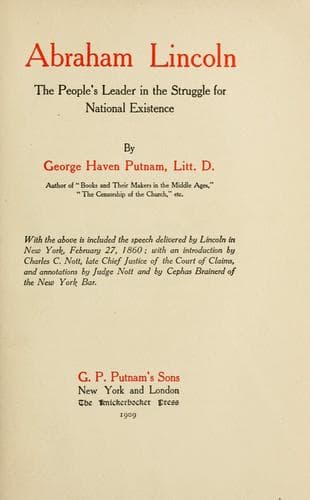
Abraham Lincoln: The People's Leader in the Struggle for National ExistencePutnam, George Haven
History
Abraham Lincoln: The People's Leader in the Struggle for National Existence
Putnam, George Haven
Lincoln, Abraham, 1809-1865; United States -- History -- Civil War, 1861-1865
Some of you delight to flaunt in our faces the warning against
sectional parties given by Washington in his Farewell Address. Less
than eight years before Washington gave that warning, he had, as
President of the United States, approved and signed an act of
Congress, enforcing the prohibition of slavery in the Northwestern
Territory, which act embodied the policy of the Government upon that
subject up to and at the very moment he penned that warning; and
about one year after he penned it, he wrote Lafayette that he
considered that prohibition a wise measure, expressing in the same
connection his hope that we should at some time have a confederacy
of free States.[28]
Bearing this in mind, and seeing that sectionalism has since arisen
upon this same subject, is that warning a weapon in your hands
against us, or in our hands against you? Could Washington himself
speak, would he cast the blame of that sectionalism upon us, who
sustain his policy, or upon you who repudiate it? We respect that
warning of Washington, and we commend it to you, together with his
example pointing to the right application of it.
But you say you are conservative--eminently conservative--while we
are revolutionary, destructive, or something of the sort. What is
conservatism? Is it not adherence to the old and tried, against the
new and untried? We stick to, contend for, the identical old policy
on the point in controversy which was adopted by "our fathers who
framed the Government under which we live"; while you with one
accord reject, and scout, and spit upon that old policy, and insist
upon substituting something new. True, you disagree among yourselves
as to what that substitute shall be. You are divided on new
propositions and plans, but you are unanimous in rejecting and
denouncing the old policy of the fathers. Some of you are for
reviving the foreign slave trade; some for a Congressional
Slave-Code for the Territories; some for Congress forbidding the
Territories to prohibit Slavery within their limits; some for
maintaining Slavery in the Territories through the judiciary; some
for the "gur-reat pur-rinciple" that "if one man would enslave
another, no third man should object," fantastically called "Popular
Sovereignty"; but never a man among you in favor of federal
prohibition of slavery in federal territories, according to the
practice of "our fathers who framed the Government under which we
live." Not one of all your various plans can show a precedent or an
advocate in the century within which our Government originated.
Consider, then, whether your claim of conservatism for yourselves,
and your charge of destructiveness against us, are based on the most
clear and stable foundations.
Public-domain text, read in full here on John Shaqi.
Reviews
Reviews
No reviews yet
Be the first to share your thoughts on this work.
Elsewhere in the archive
Join the Discussion
Join the discussion
Sign in to leave a comment or review.
Sign InorCreate an account