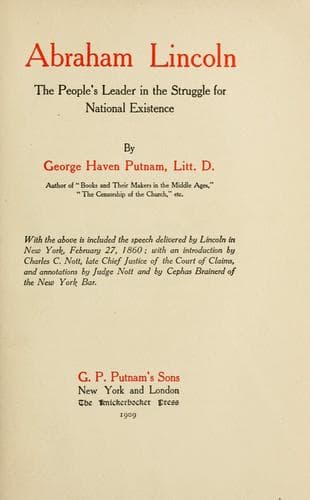
Abraham Lincoln: The People's Leader in the Struggle for National ExistencePutnam, George Haven
History
Abraham Lincoln: The People's Leader in the Struggle for National Existence
Putnam, George Haven
Lincoln, Abraham, 1809-1865; United States -- History -- Civil War, 1861-1865
sympathy with Black Republicanism; and then, to give point to the
charge, defines Black Republicanism to simply be insurrection, blood
and thunder among the slaves.
Slave insurrections are no more common now than they were before the
Republican party was organized. What induced the Southampton
insurrection, twenty-eight years ago, in which, at least, three
times as many lives were lost as at Harper's Ferry?[30] You can
scarcely stretch your very elastic fancy to the conclusion that
Southampton was "got up by Black Republicanism." In the present
state of things in the United States, I do not think a general, or
even a very extensive slave insurrection, is possible. The
indispensable concert of action cannot be attained. The slaves have
no means of rapid communication; nor can incendiary freemen, black
or white, supply it. The explosive materials are everywhere in
parcels; but there neither are, nor can be supplied, the
indispensable connecting trains.
Much is said by Southern people about the affection of slaves for
their masters and mistresses; and a part of it, at least, is true. A
plot for an uprising could scarcely be devised and communicated to
twenty individuals before some one of them, to save the life of a
favorite master or mistress, would divulge it. This is the rule; and
the slave revolution in Hayti was not an exception to it, but a case
occurring under peculiar circumstances,[31] The gunpowder plot of
British history, though not connected with slaves, was more in
point. In that case, only about twenty were admitted to the secret;
and yet one of them, in his anxiety to save a friend, betrayed the
plot to that friend, and, by consequence, averted the calamity.
Occasional poisonings from the kitchen, and open or stealthy
assassinations in the field, and local revolts extending to a score
or so, will continue to occur as the natural results of slavery; but
no general insurrection of slaves, as I think, can happen in this
country for a long time. Whoever much fears, or much hopes for such
an event, will be alike disappointed.
In the language of Mr. Jefferson, uttered many years ago, "It is
still in our power to direct the process of emancipation, and
deportation, peaceably, and in such slow degrees, as that the evil
will wear off insensibly; and their places be, _pari passu_, filled
up by free white laborers. If, on the contrary, it is left to force
itself on, human nature must shudder at the prospect held up."[32]
Public-domain text, read in full here on John Shaqi.
Reviews
Reviews
No reviews yet
Be the first to share your thoughts on this work.
Elsewhere in the archive
Join the Discussion
Join the discussion
Sign in to leave a comment or review.
Sign InorCreate an account