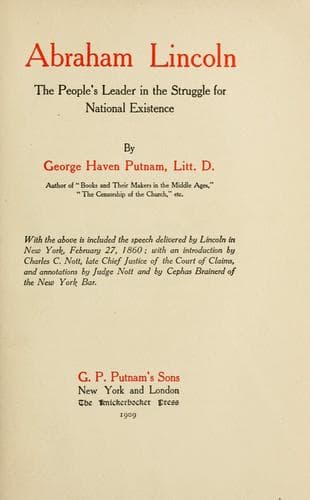
Abraham Lincoln: The People's Leader in the Struggle for National ExistencePutnam, George Haven
History
Abraham Lincoln: The People's Leader in the Struggle for National Existence
Putnam, George Haven
Lincoln, Abraham, 1809-1865; United States -- History -- Civil War, 1861-1865
I am quite aware they do not state their case precisely in this way.
Most of them would probably say to us, "Let us alone, _do_ nothing
to us, and _say_ what you please about slavery." But we do let them
alone--have never disturbed them--so that, after all, it is what we
say, which dissatisfies them. They will continue to accuse us of
doing, until we cease saying.
I am also aware they have not, as yet, in terms, demanded the
overthrow of our Free-State Constitutions.[39] Yet those
Constitutions declare the wrong of slavery, with more solemn
emphasis, than do all other sayings against it; and when all these
other sayings shall have been silenced, the overthrow of these
Constitutions will be demanded, and nothing be left to resist the
demand. It is nothing to the contrary, that they do not demand the
whole of this just now. Demanding what they do, and for the reason
they do, they can voluntarily stop nowhere short of this
consummation. Holding, as they do, that slavery is morally right,
and socially elevating, they cannot cease to demand a full national
recognition of it, as a legal right, and a social blessing.[40]
Nor can we justifiably withhold this on any ground save our
conviction that slavery is wrong. If slavery is right, all words,
acts, laws, and constitutions against it, are themselves wrong, and
should be silenced, and swept away. If it is right, we cannot justly
object to its nationality--its universality; if it is wrong, they
cannot justly insist upon its extension--its enlargement. All they
ask, we could readily grant, if we thought slavery right; all we
ask, they could as readily grant, if they thought it wrong.[41]
Their thinking it right, and our thinking it wrong, is the precise
fact upon which depends the whole controversy. Thinking it right, as
they do, they are not to blame for desiring its full recognition, as
being right; but, thinking it wrong, as we do, can we yield to them?
Can we cast our votes with their view, and against our own? In view
of our moral, social, and political responsibilities, can we do
this?
Public-domain text, read in full here on John Shaqi.
Reviews
Reviews
No reviews yet
Be the first to share your thoughts on this work.
Elsewhere in the archive
Join the Discussion
Join the discussion
Sign in to leave a comment or review.
Sign InorCreate an account