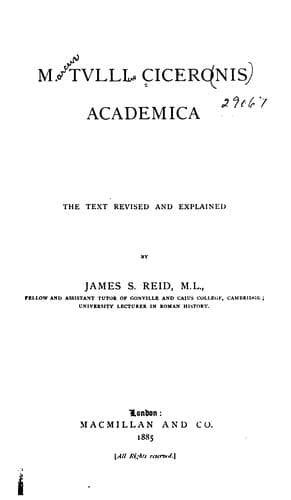
Knowledge, Theory of -- Early works to 1800; Philosophy -- Early works to 1800
§10. _Causa_: = προφασις. _Probabilem_: = specious. _Nesciunt_: Halm with
his one MS. G, which is the work of a clever emendator, gives _nescient_ to
suit _malent_ above, and is followed by Baiter. It is not necessary to
force on Cic. this formally accurate sequence of tenses, which Halm himself
allows to be broken in two similar passages, II. 20, 105. _Sed da mihi
nunc, satisne probas?_: So all MSS. except G, which has the evident conj.
_sed ea (eam) mihi non sane probas_. This last Baiter gives, while Halm
after Durand reads _sed eam mihi non satis probas_, which is too far from
the MSS. to please me. The text as it stands is not intolerable, though _da
mihi_ for _dic mihi_ is certainly poetic. _Da te mihi_ (Manut., Goer.,
Orelli) is far too strong for the passage, and cannot be supported by 12,
_Brut._ 306, _Ad Fam._ II. 8, or such like passages. _Attius_: the old
spelling _Accius_ is wrong. _Si qui ... imitati_: note the collocation, and
cf. 17. Halm needlessly writes _sint_ for MSS. _sunt_. For this section
throughout cf. the prologues to _D.F._ I., _T.D._ I. and II.
§11. _Procuratio_: for the proper meaning of _procurator_ and _procuratio_
see Jordan on _Pro Caecina_ 55. _Implacatum et constrictum_: the
conjunction introduces the intenser word, as usual; cf. 17 _plenam ac
refertam_, II. 127 _exigua et minima_, so και in Greek. _Inclusa habebam_:
cf. _T.D._ I. 1. _Obsolescerent_, used of _individual_ memory, is
noteworthy. _Percussus volnere_: many edd. give the frequent variant
_perculsus_. The _volnus_, which Goer. finds so mysterious, is the death of
Tullia, cf. _N.D._ I. 9, _De Consolatione_, fragment 7, ed. Nobbe, and
Introd. p. 32. _Aut ... aut ... aut ... aut_: This casting about for an
excuse shows how low philosophy stood in public estimation at Rome. See
Introd. p. 29. The same elaborate apologies often recur, cf. esp the
exordium of _N.D._ I.
§12. _Brutus_: the same praise often recurs in _D.F._ and the _Brutus
Graecia desideret_ so all Halm's MSS., except G, which has _Graeca_. Halm
(and after him Baiter) adopts the conj. of Aldus the younger, _Graeca
desideres_. A reviewer of Halm, in Schneidewin's _Philologus_ XXIV. 483,
approves the reading on the curious ground that Brutus was not anxious to
satisfy Greek requirements, but rather to render it unnecessary for Romans
to have recourse to Greece for philosophy. I keep the MSS. reading, for
Greece with Cicero is the supreme arbiter of performance in philosophy, if
she is satisfied the philosophic world is tranquil. Cf. _Ad Att._ I. 20, 6,
_D.F._ I. 8, _Ad Qu. Fr._ II. 16, 5. I just note the em. of Turnebus, _a
Graecia desideres_, and that of Dav. _Graecia desideretur_. _Eandem
sententiam_: cf. Introd. p. 56. _Aristum_: cf. II. 11, and _M.D.F._ V. 8.
Public-domain text, read in full here on John Shaqi.
Reviews
Reviews
No reviews yet
Be the first to share your thoughts on this work.
Elsewhere in the archive
Join the Discussion
Join the discussion
Sign in to leave a comment or review.
Sign InorCreate an account