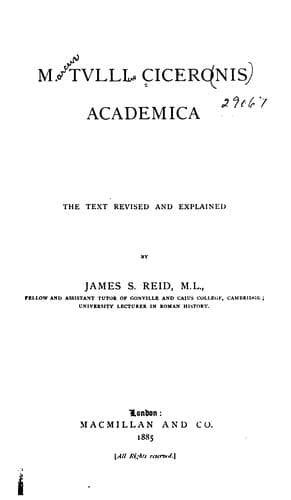
Knowledge, Theory of -- Early works to 1800; Philosophy -- Early works to 1800
§14. _A qua absum iam diu_: MSS. have strangely _aqua absumtam diu_,
changed by Manut. _Renovari_: the vulg. _revocari_ is a curious instance of
oversight. It crept into the text of Goer. by mistake, for in his note he
gave _renovari_. Orelli--who speaks of Goerenz's "_praestantissima
recensio_," and founds his own text upon it two years after Madvig's
crushing exposure in his _Em._ often quoted by me--not only reads
_revocari_, but quotes _renovari_ as an em. of the ed. Victoriana of 1536.
From Orelli, Klotz, whose text has no independent value, took it.
_Renovare_ in Cic. often means "to refresh the memory," e.g. 11, _Brut._
315. _Nisi molestum est_: like _nisi alienum putas_, a variation on the
common _si placet, si videtur_. _Adsidamus_: some MSS. have _adsideamus_,
which would be wrong here. _Sane istud_: Halm _istuc_ from G. _Inquit_: for
the late position of this word, which is often caused by its affinity for
_quoniam_, _quidem_, etc., cf. _M.D.F._ III. 20 _Quae cum essent dicta, in
conspectu consedimus (omnes)_: most edd. since Gulielmus print this without
_essent_ as a hexameter, and suppose it a quotation. But firstly, a verse
so commonplace, if familiar, would occur elsewhere in Cic. as others do, if
not familiar, would not be given without the name of its author. Secondly,
most MSS. have _sint_ or _essent_ before _dicta_. It is more probable
therefore that _omnes_ was added from an involuntary desire to make up the
hexameter rhythm. Phrases like _quae cum essent dicta consedimus_ often
occur in similar places in Cic.'s dialogues cf. _De Div._ II. 150, and
Augustine, the imitator of Cic., _Contra Academicos_, I. 25, also
_consedimus_ at the end of a clause in _Brut._ 24, and _considitur_ in _De
Or._ III. 18. _Mihi vero_: the omission of _inquit_, which is strange to
Goer., is well illustrated in _M.D.F._ I. 9. There is an odd ellipse of
_laudasti_ in _D.F._ V. 81.
§§15--42. Antiochus' view of the history of Philosophy. First part of
Varro's Exposition, 15--18. Summary. Socrates rejected physics and made
ethics supreme in philosophy (15). He had no fixed tenets, his one
doctrine being that wisdom consists in a consciousness of ignorance.
Moral exhortation was his task (16). Plato added to and enriched the
teaching of his master, from him sprang two schools which abandoned the
negative position of Socrates and adopted definite tenets, yet remained
in essential agreement with one another--the Peripatetic and the
Academic (17, 18).
Public-domain text, read in full here on John Shaqi.
Reviews
Reviews
No reviews yet
Be the first to share your thoughts on this work.
Elsewhere in the archive
Join the Discussion
Join the discussion
Sign in to leave a comment or review.
Sign InorCreate an account