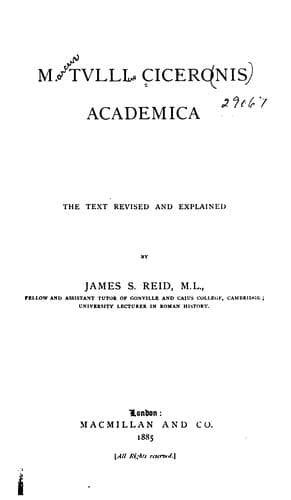
Knowledge, Theory of -- Early works to 1800; Philosophy -- Early works to 1800
§36. _Cetera_: Stoic αδιαφορα, the presence or absence of which cannot
affect happiness. The Stoics loudly protested against their being called
either _bona_ or _mala_, and this question was one of the great battle
grounds of the later Greek philosophy. _Secundum naturam ... contraria_:
Gr. κατα φυσιν, παρα φυσιν. _His ipsis ... numerabat_: I see no reason for
placing this sentence after the words _quae minoris_ below (with Christ) or
for suspecting its genuineness (with Halm). The word _media_ is the Gk.
μεσα, which word however is not usually applied to _things_, but to
_actions_. _Sumenda_: Gk. ληπτα. _Aestimatione_: αξια, positive value.
_Contraque contraria_: Cic. here as in _D.F._ III. 50 feels the need of a
word to express απαξια (negative value). (Madv. in his note on that passage
coins the word _inaestimatio._) _Ponebat esse_: cf. 19, _M.D.F._ V. 73.
§37. To cope thoroughly with the extraordinary difficulties of this section
the student must read the whole of the chapters on Stoic ethics in Zeller
and Ritter and Preller. There is no royal road to the knowledge, which it
would be absurd to attempt to convey in these notes. Assuming a general
acquaintance with Stoic ethics, I set out the difficulties thus: Cic.
appears at first sight to have made the αποπροηγμενα a subdivision of the
ληπτα (_sumenda_), the two being utterly different. I admit, with Madv.
(_D.F._ III. 50), that there is no reason for suspecting the text to be
corrupt, the heroic remedy of Dav., therefore, who reads _media_ in the
place of _sumenda_, must be rejected. Nor can anything be said for
Goerenz's plan, who distorts the Stoic philosophy in order to save Cicero's
consistency. On the other hand, I do not believe that Cic. could so utterly
misunderstand one of the cardinal and best known doctrines of Stoicism, as
to think even for a moment that the αποπροηγμενα formed a branch of the
ληπτα. This view of Madvig's is strongly opposed to the fact that Cic. in
36 had explained with perfect correctness the Stoic theory of the αδιαφορα,
nor is there anywhere in the numerous passages where he touches on the
theory any trace of the same error. My explanation is that Cic. began with
the intention to speak of the _sumenda_ only and then rapidly extended his
thought so as to embrace the whole class of αδιαφορα, which he accordingly
dealt with in the latter part of the same sentence and in the succeeding
sentence. (The remainder has its own difficulties, which I defer for the
present.) Cic. therefore is chargeable not with ignorance of Stoicism but
with careless writing. A striking parallel occurs in _D.F._ III. 52, _quae
secundum locum obtinent_, προηγμενα _id est producta nominentur, quae vel
ita appellemus, vel promota et remota_. If this language be closely
pressed, the αποπροηγμενα are made of a subdivision of the προηγμενα,
though no sensible reader would suppose Cic. to have had that intention. So
if his words in _D.F._ V.
Public-domain text, read in full here on John Shaqi.
Reviews
Reviews
No reviews yet
Be the first to share your thoughts on this work.
Elsewhere in the archive
Join the Discussion
Join the discussion
Sign in to leave a comment or review.
Sign InorCreate an account