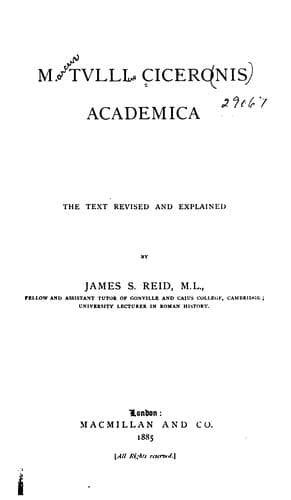
Knowledge, Theory of -- Early works to 1800; Philosophy -- Early works to 1800
IV. 8, 11, 24, 57, 82. _Quasi mortis_: a
trans. of Stoic παθεσι, which Cic. rejects in _D.F._ III. 35. _Voluit
carere sapientem_: emotion being a disturbance of equilibrium in the
reason, and perfect reason being virtue (20), it follows that the Stoic
sapiens must be emotionless (Zeller 228 sq.). All emotions are reasonless;
‛ηδονη or _laetitia_ for instance is αλογος επαρσις. (_T.D._ Books III. and
IV. treat largely of the Stoic view of emotions.) Wesenberg, _Em._ to the
_T.D._ III. p. 8, says Cic. always uses _efferri laetitia_ but _ferri
libidine_.
§39. _Aliaque in parte_: so Plato, _Tim._ 69 C, _Rep._ 436, 441, Arist. _De
Anima_ II. 3, etc.; cf. _T.D._ I. 20. _Voluntarias_: the whole aim of the
Stoic theory of the emotions was to bring them under the predominance of
the will. How the moral freedom of the will was reconciled with the general
Stoic fatalism we are not told. _Opinionisque iudicio suscipi_: all emotion
arose, said the Stoics, from a false judgment about some external object;
cf. Diog. VII. 111. τα παθη κρισεις ειναι. Instances of each in Zeller 233.
For _iudicio_ cf. _D.F._ III. 35, _T.D._ III. 61, IV. 14, 15, 18.
_Intemperantiam_: the same in _T.D._ IV. 22, Gk. ακολασια, see Zeller 232.
_Quintam naturam_: the πεμπτη ουσια or πεμπτον σωμα of Aristotle, who
proves its existence in _De Coelo_ I. 2, in a curious and recondite
fashion. Cic. is certainly wrong in stating that Arist. derived _mind_ from
this fifth element, though the finest and highest of material substances.
He always guards himself from assigning a material origin to mind. Cic.
repeats the error in _T.D._ I. 22, 41, 65, _D.F._ IV. 12. On this last
passage Madv. has an important note, but he fails to recognise the
essential fact, which is clear from Stob. I. 41, 33, that the Peripatetics
of the time were in the habit of deriving the mind from αιθηρ, which is the
very name that Aristotle gives to the fifth element (σωμα αιθεριον in the
_De Coelo_), and of giving this out to be Aristotle's opinion. The error
once made, no one could correct it, for there were a hundred influences at
work to confirm it, while the works of Aristotle had fallen into a strange
oblivion. I cannot here give an exhaustive account of these influences, but
will mention a few. Stoicism had at the time succeeded in powerfully
influencing every other sect, and it placed νους εν αιθερι (see Plutarch,
qu. R. and P. 375). It had destroyed the belief in immaterial existence The
notion that νους or ψυχη came from αιθηρ was also fostered by the language
of Plato. He had spoken of the soul as αεικινητος in passages which were
well known to Cic. and had taken great hold on his mind One from the
_Phaedrus_ 245 C is translated twice, in _Somnium Scipionis_ (_De Rep._
VI.), and _T.D._ I. 53 sq. Now the only thing with Aristotle which is
αεικινητος in eternal perfect circular motion (for to the ancients circular
motion is alone perfect and eternal), is the αιθηρ or πεμπτον σωμα, that
Public-domain text, read in full here on John Shaqi.
Reviews
Reviews
No reviews yet
Be the first to share your thoughts on this work.
Elsewhere in the archive
Join the Discussion
Join the discussion
Sign in to leave a comment or review.
Sign InorCreate an account