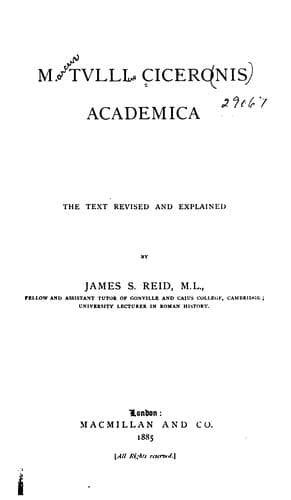
Knowledge, Theory of -- Early works to 1800; Philosophy -- Early works to 1800
§45. _Ne illud quidem_: cf. 16. _Latere censebat_ Goer. omitted _censebat_
though in most MSS. Orelli and Klotz followed as usual. For the sense II.
122. _Cohibereque_: Gk. επεχειν, which we shall have to explain in the
_Lucullus_. _Temeritatem ... turpius_: for these expressions, see II. 66,
note. _Praecurrere_: as was the case with the dogmatists. _Paria momenta_:
this is undiluted scepticism, and excludes even the possibility of the
_probabile_ which Carneades put forward. For the doctrine cf. II. 124, for
the expression Euseb. _Praep. Evan._ XIV. c. 4 (from Numenius) of
Arcesilas, ειναι γαρ παντα ακαταληπτα και τους εις εκατερα λογους
ισοκρατεις αλληλοις, Sextus _Adv. Math._ IX. 207 ισοσθενεις λογοι; in the
latter writer the word ισοσθενεια very frequently occurs in the same sense,
e g _Pyrrhon. Hyp._ I. 8 (add _N.D._ I. 10, _rationis momenta_)
§46. _Platonem_: to his works both dogmatists and sceptics appealed, Sextus
_Pyrrhon. Hyp._ I. 221 τον Πλατωνα οιν ‛οι μεν δογματικον εφασαν ειναι, ‛οι
δε απο ητικον, ‛οι δε κατα μεν τι απορητικον, κατα δε τι δογματικον.
Stobaeus II. 6, 4 neatly slips out of the difficulty; Πλατων πολυφωνος ων,
ουχ ‛ως τινες οιονται πολυδοξος. _Exposuisti_: Durand's necessary em.,
approved by Krische, Halm, etc. for MSS. _exposui_. _Zenone_: see Introd.
p. 5.
* * * * *
NOTES ON THE FRAGMENTS.
BOOK I.
1. _Mnesarchus_: see II. 69, _De Or._ I. 45, and _Dict. Biogr._
'Antipater'; cf. II. 143, _De Off._ III. 50. Evidently this fragment
belongs to that historical justification of the New Academy with which I
suppose Cicero to have concluded the first book.
2. The word _concinere_ occurs _D.F._ IV. 60, _N.D._ I. 16, in both which
places it is used of the Stoics, who are said _re concinere, verbis
discrepare_ with the other schools. This opinion of Antiochus Cic. had
already mentioned 43, and probably repeated in this fragment. Krische
remarks that Augustine, _Cont. Acad._ II. 14, 15, seems to have imitated
that part of Cicero's exposition to which this fragment belongs. If so Cic.
must have condemned the unwarrantable verbal innovations of Zeno in order
to excuse the extreme scepticism of Arcesilas (Krische, p. 58).
BOOK II.
3. This fragm. clearly forms part of those anticipatory sceptical arguments
which Cic. in the first edition had included in his answer to Hortensius,
see Introd. p. 55. The argument probably ran thus: What seems so level as
the sea? Yet it is easy to prove that it is really not level.
4. On this I have nothing to remark.
5. There is nothing distinctive about this which might enable us to
determine its connection with the dialogue. Probably Zeno is the person who
_serius adamavit honores_.
6. The changing aspects of the same thing are pointed to here as
invalidating the evidence of the senses.
7. This passage has the same aim as the last and closely resembles
_Lucullus_ 105.
Public-domain text, read in full here on John Shaqi.
Reviews
Reviews
No reviews yet
Be the first to share your thoughts on this work.
Elsewhere in the archive
Join the Discussion
Join the discussion
Sign in to leave a comment or review.
Sign InorCreate an account