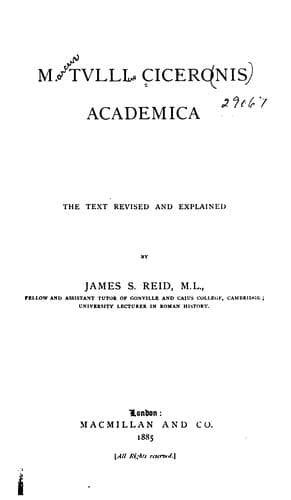
Knowledge, Theory of -- Early works to 1800; Philosophy -- Early works to 1800
§7. _Sunt ... qui negent_: and truly, see Introd. p. 38. In _Cat. Mai._ §3
Cic. actually apologises for making Cato more learned than he really was.
_Mortuis_: Catulus died in 60, Lucullus about 57, Hortensius 50. _Contra
omnis dicere quae videntur_: MSS. mostly insert _qui_ between _dicere_ and
_quae_, one of the best however has _dicere quae aliis_ as a correction,
while another has the marginal reading _qui scire sibi videntur_. The
omission of _qui_, which I conjectured, but now see occurs in a MS. (Pal.
2) referred to by Halm, gives admirable sense. _Verum invenire_: cf. 60.
_Contentione_: = φιλονεικια as usual. _In ... rebus obscuritas_: cf. I. 44
_rerum obscuritate_. _Infirmitas_: cf. I. 44 _imbecillos animos_.
_Antiquissimi et doctissimi_: on the other hand _recentissima quaeque sunt
correcta et emendata maxime_ I. 13. _Diffisi_: one of the best MSS. has
_diffissi_, which reminds one of the spelling _divisssiones_, asserted to
be Ciceronian in Quint. _Inst. Or_. I. 7, 20. _In utramque partem_: επ'
αμφοτερα, cf. I. 45. _Exprimant_: "embody," cf. n. on I. 19.
§8. _Probabilia_: πιθανα, for which see 33. _Sequi_: "act upon," cf.
99-101. _Liberiores et solutiores_: these two words frequently occur
together in Cic. and illustrate his love for petty variations; see 105,
also _T.D._ V. 43, _De Div._ I. 4, _De Rep._ IV. 4, _N.D._ I. 56, _Orat._
64. _Integra_: "untrammelled," cf. the phrase "_non mihi integrum est_"--"I
have committed my self." _Et quasi_: MSS. have _et quibus et quasi_.
_Cogimur_: for this Academic freedom see Introd. p. 18. _Amico cuidam_:
Orelli after Lamb. _cuipiam;_ for the difference see Madv. _Gram._ 493 _b_,
c.
Public-domain text, read in full here on John Shaqi.
Reviews
Reviews
No reviews yet
Be the first to share your thoughts on this work.
Elsewhere in the archive
Join the Discussion
Join the discussion
Sign in to leave a comment or review.
Sign InorCreate an account