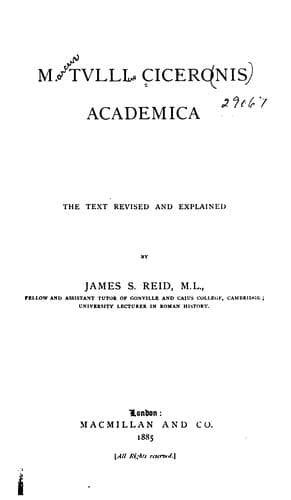
Knowledge, Theory of -- Early works to 1800; Philosophy -- Early works to 1800
§16. _Veteribus_: Bentley's em. of MSS. _vetera_: C.F. Hermann (Schneid
_Philol._ VII. 457), thinking the departure from the MSS. too great, keeps
_vetera_ and changes _incognita_ into _incondita_, comparing _De Or._ I.
197, III. 173. A glance, however, at the exx. in Forc. will show that the
word always means merely "disordered, confused" in Cic. The difference here
is not one between order and no order, but between knowledge and no
knowledge, so that _incognita_ is far better. I am not at all certain that
the MSS. reading needs alteration. If kept the sense would be: "but let us
suppose, for sake of argument, that the doctrines of the ancients were not
_knowledge_, but mere _opinion_." The conj. of Kayser _veri nota_ for
_vetera_ (cf. 76) and _investigatum_ below, is fanciful and improbable.
_Quod investigata sunt_: "in that an investigation was made." Herm. again
disturbs the text which since Madv. _Em._ 127 supported it (quoting _T.D._
V. 15, Liv. XXXV. 16) had been settled. Holding that _illa_ in the former
sentence cannot be the subj. of the verb, he rashly ejects _nihilne est
igitur actum_ as a dittographia (!) from 15 _nihilne explicatum_, and reads
_quot_ for _quod_ with Bentl. For the meaning cf. _T.D._ III. 69 and Arist.
on the progress of philosophy as there quoted. _Arcesilas Zenoni ...
obtrectans_: see n. on I. 34. These charges were brought by each school
against the other. In Plutarch _Adv. Colotem_ p. 1121 F, want of novelty is
charged against Arcesilas, and the charge is at once joyfully accepted by
Plut. The scepticism of Arcesilas was often excused by the provocation Zeno
gave, see Aug. _Contra Acad._ II. 14, 15 and notes on fragm. 2 and 35 of
the _Academica Posteriora_. _Immutatione verborum_: n. on I. 33. This
phrase has also technical meanings; it translates the Greek τροποι (_Brut._
69) and αλληγορια in _De Or._ II. 261, where an ex. is given.
_Definitiones_: n. on 18. _Tenebras obducere_: such expressions abound in
Cic. where the New Academy is mentioned, cf. 30 (_lucem eripere_), _N.D._
I. 6 (_noctem obfundere_) Aug. _Contra Ac._ III. 14 (_quasdam nebulas
obfundere_), also the joke of Aug. II. 29 _tenebrae quae patronae
Academicorum solent esse_. _Non admodum probata_: cf. the passage of
Polybius qu. by Zeller 533. _Lacyde_: the most important passages in
ancient authorities concerning him are quoted by Zeller 506. It is
important to note that Arcesilas left no writings so that Lacydes became
the source of information about his teacher's doctrines. _Tenuit_: cf. the
use of _obtinere_ in _De Or._ I. 45. _In Aeschine_: so Dav. for the
confused MSS. reading. For this philosopher see Zeller 533. As two MSS.
have _hac nonne_ Christ conj. _Hagnone_ which Halm, as well as Baiter
takes; Zeller 533 seems to adopt this and at once confuses the supposed
philosopher with one Agnon just mentioned in Quint. II. 17, 15. There is
not the slightest reason for this, Agnon and Hagnon being known, if known
Public-domain text, read in full here on John Shaqi.
Reviews
Reviews
No reviews yet
Be the first to share your thoughts on this work.
Elsewhere in the archive
Join the Discussion
Join the discussion
Sign in to leave a comment or review.
Sign InorCreate an account