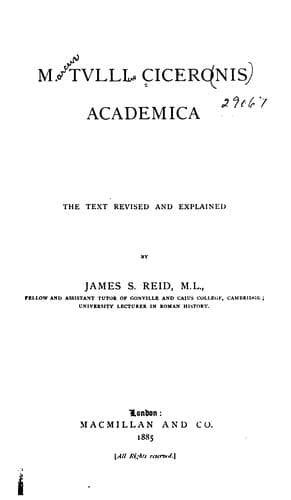
Knowledge, Theory of -- Early works to 1800; Philosophy -- Early works to 1800
which he had although απο ‛υπαρχοντος (proceeding from an actually existent
thing) was not κατα το ‛υπαρχον, i.e. did not truly represent that existent
thing. Aug. _Cont. Acad._ II. 11 quotes Cicero's definition and condenses
it thus; _his signis verum posse comprehendi quae signa non potest habere
quod falsum est_. _Iudicium_: κριτηριον, a test to distinguish between the
unknown and the known. _Eo, quo minime volt_: several things are clear, (1)
that Philo headed a reaction towards dogmatism, (2) that he based the
possibility of knowledge on a ground quite different from the καταληπτικη
φαντασια, which he pronounced impossible, (3) that he distorted the views
of Carneades to suit his own. As to (1) all ancient testimony is clear, cf.
11, Sextus _Pyrr. Hyp._ I. 235, who tells us that while the Carneadeans
believed all things to be ακαταληπτα, Philo held them to be καταληπτα, and
Numenius in Euseb. _Praep. Ev._ XIV. 8, p. 739, who treats him throughout
his notice as a renegade. (2) is evident from the _Academica_ and from
Sextus as quoted above. The foundation for knowledge which he substituted
is more difficult to comprehend. Sextus indeed tells us that he held things
to be _in their own nature_ καταληπτα (‛οσον δε επι τη φυσει των πραγματων
αυτων καταλ.). But Arcesilas and Carneades would not have attempted to
disprove this; they never tried to show that things _in themselves_ were
incognisable, _but_ that human faculties do not avail to give information
about them. Unless therefore Philo deluded himself with words, there was
nothing new to him about such a doctrine. The Stoics by their καταληπτικη
φαντασια professed to be able to get at _the thing in itself_, in its real
being, if then Philo did away with the καταλ. φαντ. and substituted no
other mode of curing the defects alleged by Arcesilas and Carneades to
reside in sense, he was fairly open to the retort of Antiochus given in the
text. Numenius treats his polemic against the καταλ. φαντ. as a mere feint
intended to cover his retreat towards dogmatism. A glimpse of his position
is afforded in 112 of this book, where we may suppose Cic. to be expressing
the views of Philo, and not those of Clitomachus as he usually does. It
would seem from that passage that he defined the cognisable to be "_quod
impressum esset e vero_" (φαντασια απο ‛υπαρχοντος εναπομεμαγμενη),
refusing to add "_quo modo imprimi non posset a falso_ (‛οια ουκ αν γενοιτο
απο μη ‛υπαρχοντος), cf. my n. on the passage. Thus defined, he most likely
tried to show that the cognisable was equivalent to the δηλον or πιθανον of
Carneades, hence he eagerly pressed the doubtful statement of the latter
that the wise man would "opine," that is, would pronounce definite
judgments on phenomena. (See 78 of this book.) The scarcity of references
to Philo in ancient authorities does not allow of a more exact view of his
doctrine. Modern inquiry has been able to add little or nothing to the
Public-domain text, read in full here on John Shaqi.
Reviews
Reviews
No reviews yet
Be the first to share your thoughts on this work.
Elsewhere in the archive
Join the Discussion
Join the discussion
Sign in to leave a comment or review.
Sign InorCreate an account