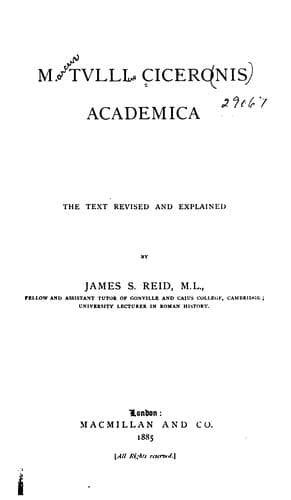
Knowledge, Theory of -- Early works to 1800; Philosophy -- Early works to 1800
declared that the Academics could not be held to be philosophers if
they had not even confidence in their one dogma (29).
§19. _Sensibus_: it is important to observe that the word _sensus_ like
αισθησις means two things, (1) one of the _five_ senses, (2) an individual
act of sensation. _Deus_: for the supposed god cf. _T.D._ II. 67. _Non
videam_: this strong statement is ridiculed in 80. _De remo inflexo et de
collo columbae_: cf. 79, 82. The κωπη εναλος κεκλασμενη and περιστερας
τραχηλος are frequently mentioned, along with numerous other instances of
the deceptiveness of sense, by Sext. Emp., e.g. _Pyrrhon. Hypot._ I.
119-121, _Adv. Math._ VII. 244, 414. Cicero, in his speech of the day
before, had probably added other examples, cf. Aug. _Cont. Ac._ III. 27.
_Epicurus hoc viderit_: see 79, 80. Epic. held all sensation, _per se_, to
be infallible. The chief authorities for this are given in R. and P. 343,
344, Zeller 403, footnote. _Lumen mutari_: cf. _Brut._ 261. _Intervalla ...
diducimus_: for this cf. Sext. _Pyrrh_. I. 118 πεμπτος εστι λογος (i.e. the
5th sceptic τροπος for showing sense to be untrustworthy) ‛ο παρα τας
θεσεις (_situs_) και τα διαστηματα (_intervalla_) και τους τοπους.
_Multaque facimus usque eo_: Sext. _Adv. Math._ VII. 258 παντα ποιει μεχρις
αν τρανην και πληκτικην σπαση φαντασιαν. _Sui iudicii_: see for the gen.
_M.D.F._ II. 27; there is an extraordinary instance in Plaut. _Persa_ V. 2,
8, quoted by Goer. _Sui cuiusque_: for this use of _suus quisque_ as a
single word see _M.D.F._ V. 46.
§20. _Ut oculi ... cantibus_: Halm after Dav. treats this as a gloss: on
the other hand I think it appropriate and almost necessary. _Quis est quin
cernat_: read Madvig's strong remarks on Goerenz's note here (_D.F._ II.
27). _Umbris ... eminentia_: Pliny (see Forc.) often uses _umbra_ and
_lumen_, to denote background and foreground, so in Gk. σκια and σκιασμα
are opposed to λαμπρα; cf. also σκιαγραφειν, _adumbrare_, and Aesch.
_Agam_. 1328. Cic. often applies metaphorically to oratory the two words
here used, e.g. _De Or._ III. 101, and after him Quintilian, e.g. II. 17,
21. _Inflatu_: cf. 86 (where an answer is given) and αναβολη. _Antiopam_:
of Pacuvius. _Andromacham_: of Ennius, often quoted by Cic., as _De Div._
I. 23. _Interiorem_: see R. and P. 165 and Zeller's _Socrates and the
Socratic Schools_, 296. _Quia sentiatur_: αισθησις being their only
κριτηριον. Madv. (without necessity, as a study of the passages referred to
in R. and P. and Zeller will show) conj. _cui adsentiatur_, comparing 39,
58; cf. also 76. _Inter eum ... et inter_: for the repetition of _inter_
cf. _T.D._ IV. 32 and Madv. _Gram._ 470. _Nihil interesse_: if the doctrine
of the Academics were true, a man might really be in pain when he fancied
himself in pleasure, and _vice versa_; thus the distinction between
pleasure and pain would be obscured. _Sentiet ... insaniat_: For the
sequence cf. _D.F._ I. 62 and Wesenberg's fine note on _T.D._ V. 102.
Public-domain text, read in full here on John Shaqi.
Reviews
Reviews
No reviews yet
Be the first to share your thoughts on this work.
Elsewhere in the archive
Join the Discussion
Join the discussion
Sign in to leave a comment or review.
Sign InorCreate an account