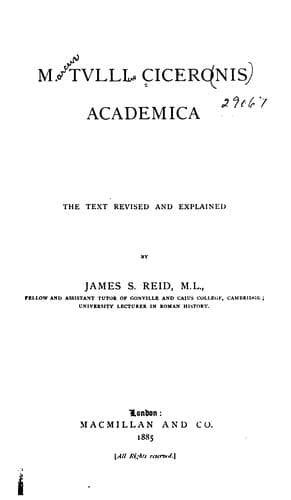
Knowledge, Theory of -- Early works to 1800; Philosophy -- Early works to 1800
§48. _Ipsa per sese_: simply = _inaniter_ as in 34, 47, i.e. without the
approach of any external object. _Cogitatione_: the only word in Latin, as
διανοια is in Greek, to express our "imagination." _Non numquam_: so Madv.
for MSS. _non inquam_. Goer. after Manut. wrote _non inquiunt_ with an
interrogation at _omnino_. _Veri simile est_: so Madv. _D.F._ III. 58 for
_sit_. The argument has the same purpose as that in the last section, viz
to show that phantom sensations may produce the same effect on the mind as
those which proceed from realities. _Ut si qui_: the _ut_ here is merely
"as," "for instance," cf. n. on 33. _Nihil ut esset_: the _ut_ here is a
repetition of the _ut_ used several times in the early part of the
sentence, all of them alike depend on _sic_. Lamb. expunged _ut_ before
_esset_ and before _quicquam_. _Intestinum et oblatum_: cf. Sext. _A.M._
VII. 241 ητοι των εκτος η των εν ‛ημιν παθων, and the two classes of _falsa
visa_ mentioned in n. on 47. _Sin autem sunt_, etc.: if there _are_ false
sensations which are probable (as the Stoics allow), why should there not
be false sensations so probable as to be with difficulty distinguishable
from the true? The rest exactly as in 47.
§§49--53. Antiochus attacked these arguments as _soritae_, and
therefore faulty (49). The admission of a certain amount of similarity
between true and false sensations does not logically lead to the
impossibility of distinguishing between the true and the false (50). We
contend that these phantom sensations lack that self evidence which we
require before giving assent. When we have wakened from the dream, we
make light of the sensations we had while in it (51). But, say our
opponents, while they last our dreaming sensations are as vivid as our
waking ones. This we deny (52). "But," say they, "you allow that the
wise man in madness withholds his assent." This proves nothing, for he
will do so in many other circumstances in life. All this talk about
dreamers, madmen and drunkards is unworthy our attention (53).
§49. _Antiochus_: Sext. often quotes him in the discussion of this and
similar subjects. _Ipsa capita_: αυτα τα κεφαλαια. _Interrogationis_: the
_sorites_ was always in the form of a series of questions, cf. _De Div._
II. 11 (where Cic. says the Greek word was already naturalised, so that his
proposed trans. _acervalis_ is unnecessary), _Hortens._ fragm. 47, and n.
on 92. _Hoc vocant_: i.e. _hoc genus_, cf. _D.F._ III. 70 _ex eo genere,
quae prosunt_. _Vitiosum_: cf. _D.F._ IV. 50 _ille sorites, quo nihil
putatis_ (Stoici) _vitiosius_. Most edd. read _hos_, which indeed in 136 is
a necessary em. for MSS. _hoc_. _Tale visum_: i.e. _falsum_. _Dormienti_:
sc. τινι. _Ut probabile sit_, etc.: cf. 47, 48 and notes. _Primum quidque_:
not _quodque_ as Klotz; cf. _M.D.F._ II. 105, to whose exx. add _De Div._
II. 112, and an instance of _proximus quisque_ in _De Off._ II. 75.
_Vitium_: cf. _vitiosum_ above.
Public-domain text, read in full here on John Shaqi.
Reviews
Reviews
No reviews yet
Be the first to share your thoughts on this work.
Elsewhere in the archive
Join the Discussion
Join the discussion
Sign in to leave a comment or review.
Sign InorCreate an account