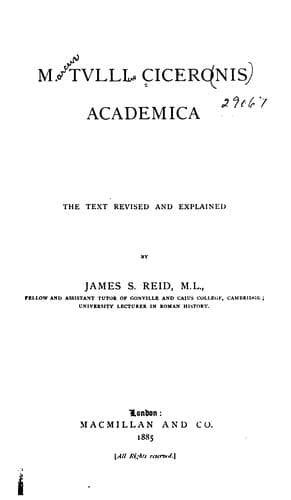
Knowledge, Theory of -- Early works to 1800; Philosophy -- Early works to 1800
§53. _Sustinet_: επεχει; see on 94. _Aliquando sustinere_: the point of the
Academic remark lay in the fact that in the state of madness the εποχη of
the _sapiens_ becomes _habitual_; he gives up the attempt to distinguish
between true and false _visa_. Lucullus answers that, did no distinction
exist, he would give up the attempt to draw it, even in the sane condition.
_Confundere_: so 58, 110, Sext. _A.M._ VIII. 56 (συγχεουσι τα πραγματα),
_ib._ VIII. 157 (συγχεομεν τον βιον), VIII. 372 (‛ολην συγχεει την
φιλοσοφον ζητησιν), Plut. _De Communi Notit. adv. Stoicos_ p. 1077 (‛ως
παντα πραγματα συγχεουσι). _Utimur_: "we have to put up with," so χρησθαι
is used in Gk. _Ebriosorum_: "habitual drunkards," more invidious than
_vinolenti_ above. _Illud attendimus_: Goer., and Orelli write _num illud_,
but the emphatic _ille_ is often thus introduced by itself in questions, a
good ex. occurs in 136. _Proferremus_: this must apparently be added to the
exx. qu. by Madv. on _D.F._ II. 35 of the subj. used to denote "_non id
quod fieret factumve esset, sed quod fieri debuerit_." As such passages are
often misunderstood, I note that they can be most rationally explained as
elliptic constructions in which a _condition_ is expressed without its
_consequence_. We have an exact parallel in English, e.g. "_tu dictis
Albane maneres_" may fairly be translated, "hadst thou but kept to thy
word, Alban!" Here the condition "_if_ thou hadst kept, etc." stands
without the consequence "thou wouldst not have died," or something of the
kind. Such a condition may be expressed without _si_, just as in Eng.
without "_if_," cf. Iuv. III. 78 and Mayor's n. The use of the Greek
optative to express a wish (with ει γαρ, etc., and even without ει) is
susceptible of the same explanation. The Latin subj. has many such points
of similarity with the Gk. optative, having absorbed most of the functions
of the lost Lat. optative. [Madv. on _D.F._ II. 35 seems to imply that he
prefers the hypothesis of a suppressed protasis, but as in his _Gram._ 351
_b_, obs. 4 he attempts no elucidation, I cannot be certain.]
Public-domain text, read in full here on John Shaqi.
Reviews
Reviews
No reviews yet
Be the first to share your thoughts on this work.
Elsewhere in the archive
Join the Discussion
Join the discussion
Sign in to leave a comment or review.
Sign InorCreate an account