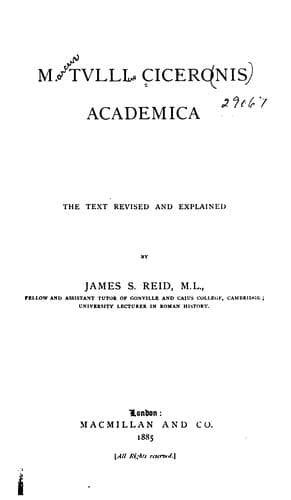
Knowledge, Theory of -- Early works to 1800; Philosophy -- Early works to 1800
§79. _Communi loco_: τοπω, that of blinking facts which cannot be
disproved, see 19. _Quod ne_ [_id_]: I have bracketed _id_ with most edd.
since Manut. If, however, _quod_ be taken as the conjunction, and not as
the pronoun, _id_ is not altogether insupportable. _Heri_: cf. Introd. 55.
_Infracto remo_: n. on 19. Tennyson seems to allude to this in his "Higher
Pantheism"--"all we have power to see is a straight staff bent in a pool".
_Manent illa omnia, iacet_: this is my correction of the reading of most
MSS. _maneant ... lacerat_. Madv. _Em._ 176 in combating the conj. of Goer.
_si maneant ... laceratis istam causam_, approves _maneant ... iaceat_, a
reading with some MSS. support, adopted by Orelli. I think the whole
confusion of the passage arises from the mania of the copyists for turning
indicatives into subjunctives, of which in critical editions of Cic. exx.
occur every few pages. If _iacet_ were by error turned into _iaceret_ the
reading _lacerat_ would arise at once. The nom. to _dicit_ is, I may
observe, not Epicurus, as Orelli takes it, but Lucullus. Trans. "all my
arguments remain untouched; your case is overthrown, yet his senses are
true quotha!" (For this use of _dicit_ cf. _inquit_ in 101, 109, 115).
Hermann approves the odd reading of the ed. Cratandriana of 1528 _latrat_.
Dav. conjectured comically _blaterat iste tamen et_, Halm _lacera est ista
causa_. _Habes_: as two good MSS. have _habes et eum_, Madv. _Em._ 176
conj. _habet_. The change of person, however, (from _dicit_ to _habes_)
occurs also in 101. _Epicurus_: n. on 19.
Public-domain text, read in full here on John Shaqi.
Reviews
Reviews
No reviews yet
Be the first to share your thoughts on this work.
Elsewhere in the archive
Join the Discussion
Join the discussion
Sign in to leave a comment or review.
Sign InorCreate an account