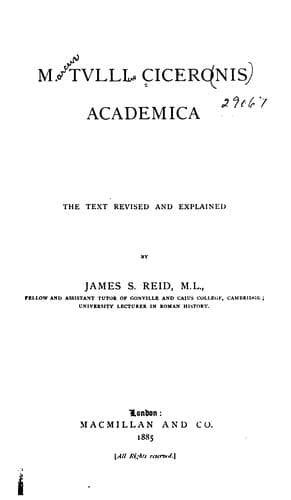
Knowledge, Theory of -- Early works to 1800; Philosophy -- Early works to 1800
§81. _Nescio qui_: Goer. is quite wrong in saying that _nescio quis_
implies contempt, while _nescio qui_ does not, cf. _Div. in qu. Caec._ 47,
where _nescio qui_ would contradict his rule. It is as difficult to define
the uses of the two expressions as to define those of _aliquis_ and
_aliqui_, on which see 61 n. In _Paradoxa_ 12 the best MSS. have _si qui_
and _si quis_ almost in the same line with identically the same meaning
Dav. quotes Solinus and Plin. _N.H._ VII. 21, to show that the man
mentioned here was called Strabo--a misnomer surely. _Octingenta_: so the
best MSS., not _octoginta_, which however agrees better with Pliny. _Quod
abesset_: "_whatever_ might be 1800 stadia distant," _aberat_ would have
implied that Cic. had some _particular_ thing in mind, cf. Madv. _Gram._
364, obs. 1. _Acrius_: οξυτερον, Lamb. without need read _acutius_ as Goer.
did in 69. _Illos pisces_: so some MSS., but the best have _ullos_, whence
Klotz conj. _multos_, Orelli _multos illos_, omitting _pisces_. For the
allusion to the fish, cf. _Acad. Post._ fragm. 13. _Videntur_: n. on 25.
_Amplius_: cf. 19 _non video cur quaerat amplius_. _Desideramus_: Halm,
failing to understand the passage, follows Christ in reading _desiderant_
(i.e. _pisces_). To paraphrase the sense is this "But say my opponents, the
Stoics and Antiocheans, we desire no better senses than we have." Well you
are like the mole, which does not yearn for the light because it does not
know what light is. Of course all the ancients thought the mole blind. A
glance will show the insipidity of the sense given by Halm's reading.
_Quererer cum deo_: would enter into an altercation with the god. The
phrase, like λοιδορεσθαι τινι as opposed to λοιδορειν τινα implies mutual
recrimination, cf. _Pro Deiotaro_ 9 _querellae cum Deiotaro_. The reading
_tam quererer_ for the _tamen quaereretur_ of the MSS. is due to Manut.
_Navem_: Sextus often uses the same illustration, as in _P.H._ I. 107,
_A.M._ VII. 414. _Non tu verum testem_, etc.: cf. 105. For the om. of _te_
before _habere_, which has strangely troubled edd. and induced them to
alter the text, see n. on I. 6.
Public-domain text, read in full here on John Shaqi.
Reviews
Reviews
No reviews yet
Be the first to share your thoughts on this work.
Elsewhere in the archive
Join the Discussion
Join the discussion
Sign in to leave a comment or review.
Sign InorCreate an account