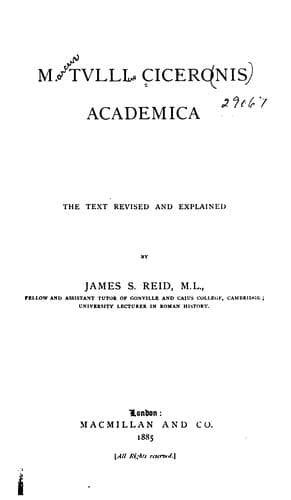
Knowledge, Theory of -- Early works to 1800; Philosophy -- Early works to 1800
§85. _Quod non est_: = _qu. n. e. id quod esse videtur_. _Sui generis_: cf.
50, 54, 56. _Nullum esse pilum_, etc.: a strong expression of this belief
is found in Seneca _Ep._. 113, 13, qu. R. and P. 380. Note the word
_Stoicum_; Lucullus is of course not Stoic, but Antiochean. _Nihil
interest_: the same opinion is expressed in 40, where see my note. _Visa
res_: Halm writes _res a re_, it is not necessary, however, either in Gk.
or Lat. to express _both_ of two related things when a word is inserted
like _differat_ here, which shows that they _are_ related. Cf. the elliptic
constructions in Gk. with ‛ομοιον, μεταξυ, μεσος, and such words. _Eodem
caelo atque_: a difficult passage. MSS. have _aqua_, an error easy, as Halm
notes, to a scribe who understood _caelum_ to be the heaven, and not
γλυφειον, a graving tool. Faber and other old edd. defend the MSS. reading,
adducing passages to show that sky and water were important in the making
of statues. For _aqua_ Orelli conj. _acu_ = _schraffirnadel_, C.F. Hermann
_caelatura_, which does not seem to be a Ciceronian word. Halm's _aeque_
introduces a construction with _ceteris omnibus_ which is not only not
Ciceronian, but not Latin at all. I read _atque_, taking _ceteris omnibus_
to be the abl. neut. "all the other implements." Formerly I conj. _ascra_,
or _atque in_, which last leading would make _omnibus_ = _om. statuis_.
_Alexandros_: Lysippus alone was privileged to make statues of Alexander,
as Apelles alone was allowed to paint the conqueror, cf. _Ad Fam._ V. 12,
7.
§86. _Anulo_: cf. 54. _Aliqui_: n. on 61. _Gallinarium_: cf. 57. _Adhibes
artem_: cf. 20 _adhibita arte_. _Pictor ... tibicen_: so in 20. _Simul
inflavit_: note _simul_ for _simul atque_, cf. _T.D._ IV. 12. _Nostri
quidem_: i.e. _Romani_. _Admodum_: i.e. _adm. pauci_ cf. _De Leg._ III. 32
_pauci enim atque admodum pauci_. _Praeclara_: evidently a fem. adj.
agreeing with _natura_. Dav. and Ern. made the adj. neuter, and
understanding _sunt_ interpreted "these arguments I am going to urge are
grand, viz. _quanto art_. etc."
§87. _Scilicet_: Germ. "natürlich." _Fabricata sit_: cf. 30, 119, 121 and
N.D. I. 19. _Ne modo_: for _modo ne_, a noticeable use. _Physicis_:
probably neut. _Contra sensus_: he wrote both for and against συνηθεια; cf.
R. and P. 360 and 368. _Carneadem_: Plut. _Sto. Rep_. 1036 B relates that
Carneades in reading the arguments of Chrysippus against the senses, quoted
the address of Andromache to Hector: δαιμονιε φθισει σε το σον μενος. From
Diog. IV. 62 we learn that he thus parodied the line qu. in n. on 75, ει μη
γαρ ην Χρυσιππος ουκ αν ην εγω.
Public-domain text, read in full here on John Shaqi.
Reviews
Reviews
No reviews yet
Be the first to share your thoughts on this work.
Elsewhere in the archive
Join the Discussion
Join the discussion
Sign in to leave a comment or review.
Sign InorCreate an account