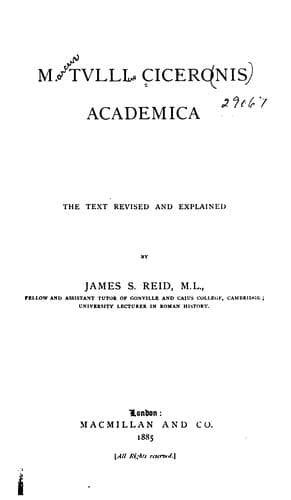
Knowledge, Theory of -- Early works to 1800; Philosophy -- Early works to 1800
§§98--105. Summary. In order to overthrow at once the case of
Antiochus, I proceed to explain, after Clitomachus, the whole of
Carneades' system (98). Carneades laid down two divisions of _visa_,
one into those capable of being perceived and those not so capable, the
other into probable and improbable. Arguments aimed at the senses
concern the first division only; the sapiens will follow probability,
as in many instances the Stoic sapiens confessedly does (99, 100). Our
sapiens is not made of stone; many things _seem_ to him true; yet he
always feels that there is a possibility of their being false. The
Stoics themselves admit that the senses are often deceived. Put this
admission together with the tenet of Epicurus, and perception becomes
impossible (101). It is strange that our _Probables_ do not seem
sufficient to you. Hear the account given by Clitomachus (102). He
condemns those who say that sensation is swept away by the Academy;
nothing is swept away but its _necessary_ certainty (103). There are
two modes of withholding assent; withholding it absolutely and
withholding it merely so far as to deny the _certainty_ of phenomena.
The latter mode leaves all that is required for ordinary life (104).
§98. _Tortuosum_: similar expressions are in _T.D._ II. 42, III. 22, _D.F._
IV. 7. _Ut Poenus_: "as might be expected from a Carthaginian;" cf. _D.F._
IV. 56, _tuus ille Poenulus, homo acutus_. A different meaning is given by
the _ut_ in passages like _De Div._ II. 30 _Democritus non inscite nugatur,
ut physicus, quo genere nihil arrogantius_; "for a physical philosopher."
§99. _Genera_: here = classifications of, modes of dividing _visa_. This
way of taking the passage will defend Cic. against the strong censure of
Madv. (Pref. to _D.F._ p. lxiii.) who holds him convicted of ignorance, for
representing Carneades as dividing _visa_ into those which can be perceived
and those which cannot. Is it possible that any one should read the
_Academica_ up to this point, and still believe that Cic. is capable of
supposing, even for a moment, that Carneades in any way upheld καταληψις?
_Dicantur_: i.e. _ab Academicis_. _Si probabile_: the _si_ is not in MSS.
Halm and also Bait. follow Christ in reading _est, probabile nihil esse_.
_Commemorabas_: in 53, 58. _Eversio_: cf. _D.F._ III. 50 (the same words),
Plat. _Gorg_. 481 C ‛ημων ‛ο βιος ανατετραμμενος αν ειη, Sext. _A.M._ VIII.
157 συγχεομεν τον βιον. _Et sensibus_: no second _et_ corresponds to this;
_sic_ below replaces it. See Madv. _D.F._ p. 790, ed. 2. _Quicquam tale_
etc.: cf. 40, 41. _Nihil ab eo differens_: n. on 54. _Non comprehensa_: n.
on 96.
Public-domain text, read in full here on John Shaqi.
Reviews
Reviews
No reviews yet
Be the first to share your thoughts on this work.
Elsewhere in the archive
Join the Discussion
Join the discussion
Sign in to leave a comment or review.
Sign InorCreate an account