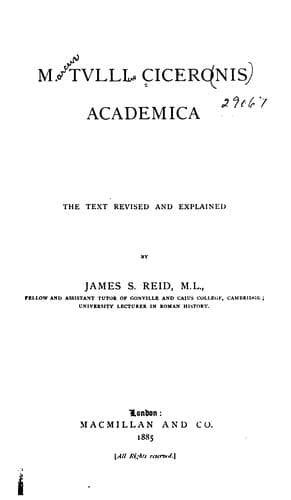
Knowledge, Theory of -- Early works to 1800; Philosophy -- Early works to 1800
§104. _Exposuisset adiungit_: Madv. on _D.F._ III. 67 notices a certain
looseness in the use of tenses, which Cic. displays in narrating the
opinions of philosophers, but no ex. so strong as this is produced. _Ut aut
approbet quid aut improbet_: this Halm rejects. I have noticed among recent
editors of Cic. a strong tendency to reject explanatory clauses introduced
by _ut_. Halm brackets a similar clause in 20, and is followed in both
instances by Bait. Kayser, who is perhaps the most extensive _bracketer_ of
modern times, rejects very many clauses of the kind in the Oratorical
works. In our passage, the difficulty vanishes when we reflect that
_approbare_ and _improbare_ may mean either to render an _absolute_
approval or disapproval, or to render an approval or disapproval merely
based on _probability_. For example, in 29 the words have the first
meaning, in 66 the second. The same is the case with _nego_ and _aio_. I
trace the whole difficulty of the passage to the absence of terms to
express distinctly the difference between the two kinds of assent. The
general sense will be as follows. "There are two kinds of εποχη, one which
prevents a man from expressing any assent or disagreement (in either of the
two senses above noticed), another which does not prevent him from giving
an answer to questions, provided his answer be not taken to imply absolute
approval or absolute disapproval; the result of which will be that he will
neither absolutely deny nor absolutely affirm anything, but will merely
give a qualified 'yes' or 'no,' dependent on probability." My defence of
the clause impugned is substantially the same as that of Hermann in the
_Philologus_ (vol. VII.), which I had not read when this note was first
written. _Alterum placere ... alterum tenere_: "the one is his formal
dogma, the other is his actual practice." For the force of this see my note
on _non probans_ in 148, which passage is very similar to this. _Neget ...
aiat_: cf. 97. _Nec ut placeat_: this, the MSS. reading, gives exactly the
wrong sense, for Clitomachus _did_ allow such _visa_ to stand as were
sufficient to serve as a basis for action. Hermann's _neu cui_ labours
under the same defect. Various emendations are _nam cum_ (Lamb., accepted
by Zeller 522), _hic ut_ (Manut.), _et cum_ (Dav. followed by Bait.), _sed
cum_ (Halm). The most probable of these seems to me that of Manut. I should
prefer _sic ut_, taking _ut_ in the sense of "although." _Respondere_: "to
put in as an answer," as in 93 and often. _Approbari_: sc. _putavit_. Such
changes of construction are common in Cic., and I cannot follow Halm in
altering the reading to _approbavit_.
§105. _Lucem eripimus_: cf. 30.
Public-domain text, read in full here on John Shaqi.
Reviews
Reviews
No reviews yet
Be the first to share your thoughts on this work.
Elsewhere in the archive
Join the Discussion
Join the discussion
Sign in to leave a comment or review.
Sign InorCreate an account