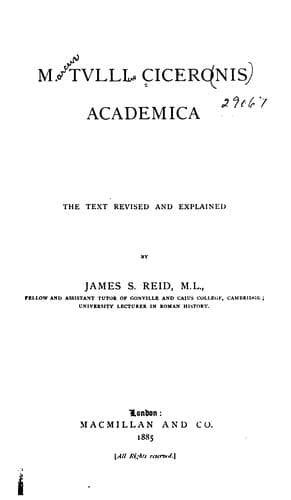
Knowledge, Theory of -- Early works to 1800; Philosophy -- Early works to 1800
§120. _Libertas ... non esse_: a remarkable construction. For the Academic
liberty see Introd. p. 18. _Quod tibi est_: after these words Halm puts
merely a comma, and inserting _respondere_ makes _cur deus_, etc. part of
the same sentence. Bait. follows. _Nostra causa_: Cic. always writes _mea,
tua, vestra, nostra causa_, not _mei, tui, nostri, vestri_, just as he
writes _sua sponte_, but not _sponte alicuius_. For the Stoic opinion that
men are the chief care of Providence, see _N.D._ I. 23, II. 37, _D.F._ III.
67, _Ac._ I. 29 etc., also Zeller. The difficulties surrounding the opinion
are treated of in Zeller 175, _N.D._ II. 91--127. They supply in Sext.
_P.H._ I. 32, III. 9--12 an example of the refutation of νοουμενα by means
of νοουμενα. _Tam multa ac_: MSS. om. _ac_, which I insert. Lactantius qu.
the passage without _perniciosa_. _Myrmecides_: an actual Athenian artist,
famed for minute work in ivory, and especially for a chariot which a fly
covered with its wings, and a ship which the wings of a bee concealed. See
Plin. _Nat. Hist._ VII. 21, XXXVI. 5.
§121. _Posse_: n. on I. 29. _Strato_: R. and P. 331. _Sed cum_: _sed_ often
marks a very slight contrast, there is no need to read _et_, as Halm.
_Asperis ... corporibus_: cf. fragm. 28 of the _Ac. Post._, also _N.D._ I.
66. _Somnia_: so _N.D._ I. 18 _miracula non disserentium philosophorum sed
somniantium_, _ib._ I. 42 _non philosophorum iudicia sed delirantium
somnia_, also _ib._ I. 66 _flagitia Democriti_. _Docentis_: giving _proof_.
_Optantis_: Guietus humorously conj. _potantis,_ Durand _oscitantis_ (cf.
_N.D._ I. 72), others _opinantis_. That the text is sound however may be
seen from _T.D._ II. 30 _optare hoc quidem est non docere_, _De Fato_ 46,
_N.D._ I. 19 _optata magis quam inventa_, _ib._ III. 12 _doceas oportet nec
proferas_; cf. also _Orat._ 59 _vocis bonitas optanda est, non est enim in
nobis_, i.e. a good voice is a thing to be prayed for, and not to be got by
exertion. There is a similar Greek proverb, ευχη μαλλον η αληθεια, in Sext.
_P.H._ VIII. 353. _Magno opere_: Hermann wishes to read _onere_. The phrase
_magnum onus_ is indeed common (cf. _De Or._ I. 116), but _magnum opus_, in
the sense of "a great task," is equally so, cf. _T.D._ III. 79, 84, _Orat._
75. _Modo hoc modo illud_: 134.
§122. _Latent ista_: see n. on fragm. 29 of the _Ac. Post._; for _latent_
cf. I. 45. Aug. _Cont. Ac._ II. 12, III. 1 imitates this passage.
_Circumfusa_: cf. I. 44, and 46 of this book. _Medici_: cf. _T.D._ I. 46
_Viderentur_: a genuine passive, cf. 25, 39, 81. _Empirici_: a school of
physicians so called. _Ut ... mutentur_: exactly the same answer was made
recently to Prof. Huxley's speculations on protoplasm; he was said to have
assumed that the living protoplasm would have the same properties as the
dead. _Media pendeat_: cf. _N.D._ II. 98, _De Or._ III. 178.
Public-domain text, read in full here on John Shaqi.
Reviews
Reviews
No reviews yet
Be the first to share your thoughts on this work.
Elsewhere in the archive
Join the Discussion
Join the discussion
Sign in to leave a comment or review.
Sign InorCreate an account