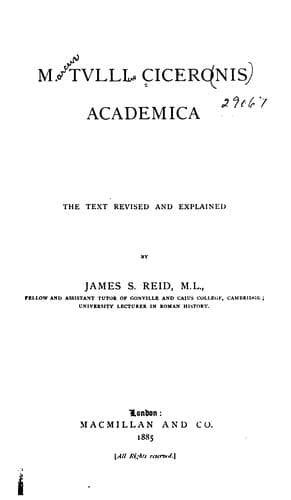
Knowledge, Theory of -- Early works to 1800; Philosophy -- Early works to 1800
§143. _Ne maiorum quidem suorum_: sc. _aliquid probat_. For _maiorum_ cf.
80. Here Plato is almost excluded from the so-called _vetus Academia_, cf.
I. 33. _Libri_: titles of some are preserved in Diog. Laert. IV. 11--14.
_Nihil politius_: cf. 119, n. _Pedem nusquam_: for the ellipse cf. 58, 116,
_Pro Deiot._ 42 and _pedem latum_ in Plaut. _Abutimur_: this verb in the
rhetorical writers means to use words in metaphorical or unnatural senses,
see Quint. X. 1, 12. This is probably the meaning here; "do we use the name
Academic in a non natural fashion?" _Si dies est lucet_: a better trans of
ει φως εστιν, ‛ημερα εστιν than was given in 96, where see n. _Aliter
Philoni_: not Philo of Larissa, but a noted dialectician, pupil of Diodorus
the Megarian, mentioned also in 75. The dispute between Diodorus and Philo
is mentioned in Sext. _A.M._ VIII. 115--117 with the same purpose as here,
see also Zeller 39. _Antipater_: the Stoic of Tarsus, who succeeded
Diogenes Babylonius in the headship of the school. _Archidemus_: several
times mentioned with Antipater in Diog., as VII. 68, 84. _Opiniosissimi_:
so the MSS. I cannot think that the word is wrong, though all edd. condemn
it. Halm is certainly mistaken in saying that a laudatory epithet such as
_ingeniosissimi_ is necessary. I believe that the word _opiniosissimi_ (an
adj. not elsewhere used by Cic.) was manufactured on the spur of the
moment, in order to ridicule these two philosophers, who are playfully
described as men full of _opinio_ or δοξα--just the imputation which, as
Stoics, they would most repel. Hermann's _spinosissimi_ is ingenious, and
if an em. were needed, would not be so utterly improbable as Halm thinks.
§144. _In contionem vocas_: a retort, having reference to 14, cf. also 63,
72. For these _contiones_ see Lange, _Romische Alterthumer_ II. 663, ed 2.
They were called by and held under the presidency of magistrates, all of
whom had the right to summon them, the right of the tribune being under
fewer restrictions than the right of the others. _Occludi tabernas_ in
order of course that the artisans might all be at the meeting, for this see
Liv. III. 27, IV. 31, IX. 7, and compare the cry "to your tents, O Israel"
in the Bible. _Artificia_: n. on 30. _Tolli_: n. on 26. _Ut opifices
concitentur_: cf. _Pro Flacc._ 18 _opifices et tabernarios quid neqoti est
concitare?_ _Expromam_: Cic. was probably thinking of the use to which he
himself had put these Stoic paradoxes in _Pro Murena_ 61, a use of which he
half confesses himself ashamed in _D.F._ IV. 74. _Exsules_ etc.: 136.
Public-domain text, read in full here on John Shaqi.
Reviews
Reviews
No reviews yet
Be the first to share your thoughts on this work.
Elsewhere in the archive
Join the Discussion
Join the discussion
Sign in to leave a comment or review.
Sign InorCreate an account