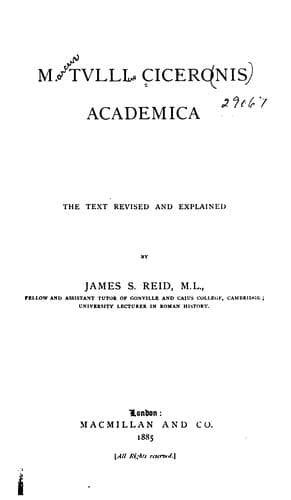
Knowledge, Theory of -- Early works to 1800; Philosophy -- Early works to 1800
[284] II. §§147, 148.
[285] II. §135.
[286] Cf. II. §§11, 12 with the words _quae erant contra_ ακαταληψιαν
_praeclare collecta ab Antiocho_: _Ad Att._ XIII. 19, §3.
[287] Varro, _De Re Rust._ III. 17.
[288] II. §11.
[289] _Paradoxa_, §1. _D.F._ III. §8. _Brutus_, §119.
[290] _Ac._ I. §12. _D.F._ V. §8.
[291] Cf. II. §80.
[292] Cf. Aug. _Adv. Acad._ III. §35. Nonius, sub v. _exultare_.
[293] Cf. the word _nuper_ in §1.
[294] §11.
[295] §§3, 18.
[296] _Ad Fam._ IX. 8, §1.
[297] _Ad Att._ II. 25, §1.
[298] _Ibid_. III. 8, §3.
[299] _Ibid_. III. 15, §3; 18, §1.
[300] _Ad Fam._ IX. 1--8. They are the only letters from Cicero to Varro
preserved in our collections.
[301] Above, pp. xxxvii--xlii.
[302] _De Civ. Dei_, XIX. cc. 1--3.
[303] See Madvig, _De Fin._ ed. 2, p. 824; also Krische, pp. 49, 50.
Brückner, _Leben des Cicero_, I. p. 655, follows Müller.
[304] Cf. Krische, p. 58.
End of the Project Gutenberg EBook of Academica, by Marcus Tullius Cicero
Public-domain text, read in full here on John Shaqi.
Reviews
Reviews
No reviews yet
Be the first to share your thoughts on this work.
Elsewhere in the archive
Join the Discussion
Join the discussion
Sign in to leave a comment or review.
Sign InorCreate an account