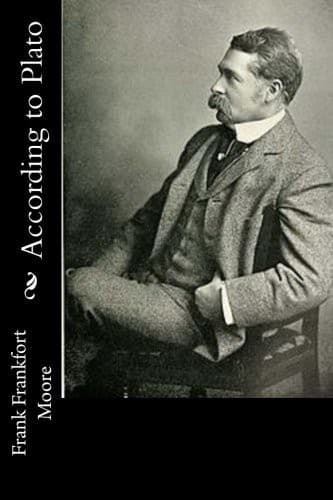
London (England) -- Social life and customs -- Fiction; Love -- Fiction; Political fiction; Satire
“My dear girl,” said he, smiling a smile which he had provisionally
patented since his daughter had made it a practice to consult him
on curious points of psychology and diction and deportment. “My dear
daughter, I have, as you well know, little time to devote to the study
of temperament or poetry or unpractical things of that sort, but I have
seen enough in the course of a busy but not wholly unobservant life, to
convince me that when a young woman goes so far as to confess that she
hates any particular young man, or old man, for that matter--she has
gone very far in the direction of saying that she loves that particular
man. I don’t say that Josephine----”
“She doesn’t. She doesn’t--at least--I don’t believe that she has
thought about him one way or another. She was, however, quite polite to
him today.”
“That’s rather a bad sign, isn’t it? When a girl is polite to a man whom
she hates, she makes one feel that his chances with her are reduced. But
of one thing you may be sure--yea, of two things you may be certain; the
first is that no girl hates a man of whom she has not been thinking a
great deal; the second is that no girl hates a man unless she knows that
he loves her.”
“How curious! How very curious! You are sure--quite sure?”
“There are variants,” said the man of science. “But one cannot study
the properties of the positive and negative currents of electricity for
forty years without learning something of the elementary principles of
attraction and repulsion. The air was, I think, strongly charged with
electricity when the first woman was born; and that being so, don’t you
think you might do worse than ask Winwood and Josephine to join us at
The Weir, some of these days?”
He was smoothing her hair very gently: the action was prettily paternal
but it was also strictly businesslike; for was he not the inventor of
that microelectrometer which is so marvellously sensitive that it is
capable of measuring the force of the current generated by the stroking
of a cat. He had experimented on his daughter years ago. No penalty
attached to his doing so, though had he tried his electrometer on the
cat he would have laid himself open to a criminal prosecution.
She was all unconscious of the escaping ohms; she was puzzling out
the hard saying that had come from her father. She was trying to see
daylight through the obstructions of his phrases and the obscuration of
his logic.
She shook her head--for the third time--saying: “I’m in a bit of a mist
just now. I should like to think it all out.”
Public-domain text, read in full here on John Shaqi.
Reviews
Reviews
No reviews yet
Be the first to share your thoughts on this work.
Elsewhere in the archive
Join the Discussion
Join the discussion
Sign in to leave a comment or review.
Sign InorCreate an account