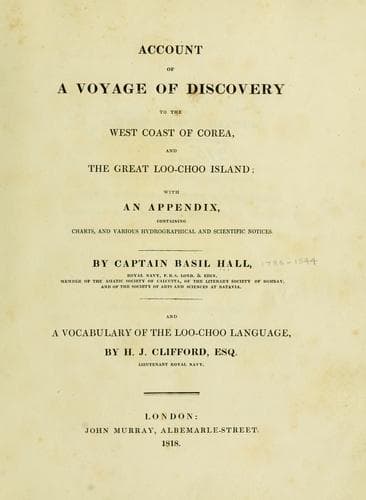
Account of a voyage of discovery to the west coast of Corea, and the great Loo-Choo IslandHall, Basil
History
Account of a voyage of discovery to the west coast of Corea, and the great Loo-Choo Island
Hall, Basil
Korea -- Description and travel; Ryukyu Islands -- Description and travel
We had never been able to obtain from the natives any clear account of
former visitors, and as the Prince was thought a likely person to be in
possession of the desired information, questions were asked him upon
this subject. He said that a vessel had been here about twenty years
ago, and that she went away immediately without holding any
communication with the court. This must have been the schooner in which
Captain Broughton visited Napakiang in July, 1797, after he had been
wrecked in his majesty's ship Providence, on the island of Typinsan[13].
He said that he knew of no other stranger who had visited Loo-choo. On
being interrogated as to the knowledge of other countries, he declared
that they knew nothing of the English or French, or any nation indeed
but the Chinese, Corean, and Japanese. Something was said about Manilla,
and from its not being very remote, it is possible that some
communication may have existed between that place and Loo-choo. Their
accounts, however, were vague and unsatisfactory, and it is not
impossible that we ourselves may have first suggested the name, and
afterwards ascribed the use of it to them[14].
Nothing, however, that occurred to-day, attracted more notice than
Madera's assumption of his long concealed rank. He came for the first
time dressed in the robes and hatchee-matchee of a chief, and not only
took precedence of all our old friends, but during the discussion in the
cabin with the Prince, maintained a decided superiority over them all.
While all the rest were embarrassed in the Prince's presence, and
crouching on their knees every time they spoke, Madera, though always
respectful, was quite at his ease; and we could not help fancying that
he addressed the Prince as if accustomed to his society. It was no less
remarkable, that the Prince referred much oftener to him than to any of
the rest, and listened to what he said with greater attention. Whether
Madera owed such distinction to his actual rank, which may have placed
him about the court, or to the ascendancy of his talents, or to the
accidental circumstance of his having had better opportunities of
knowing us than any other of the natives, we could never discover. He
admitted, when interrogated, that he had often seen the Prince before,
while the other chiefs confessed their ignorance even of his person,
before to-day.
Public-domain text, read in full here on John Shaqi.
Reviews
Reviews
No reviews yet
Be the first to share your thoughts on this work.
Elsewhere in the archive
Join the Discussion
Join the discussion
Sign in to leave a comment or review.
Sign InorCreate an account