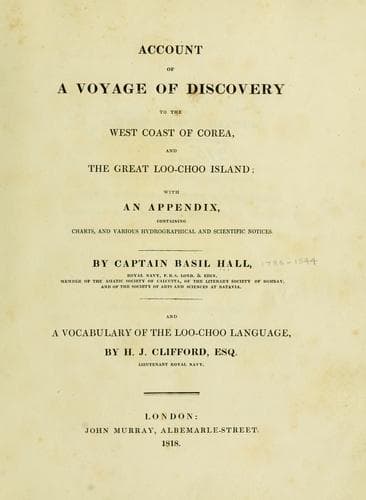
Account of a voyage of discovery to the west coast of Corea, and the great Loo-Choo IslandHall, Basil
History
Account of a voyage of discovery to the west coast of Corea, and the great Loo-Choo Island
Hall, Basil
Korea -- Description and travel; Ryukyu Islands -- Description and travel
With a sextant on a stand, I made him take the distance between the sun
and moon, four or five times; on every occasion he was wonderfully near
the truth. We endeavoured to confine him to one object, merely to
ascertain the time of apparent noon; and I think we succeeded in
explaining to him how this was to be done. He expressed repeatedly his
regret at our approaching departure, in which sentiment he was joined by
Jeeroo and the rest of the chiefs, who were quite out of spirits.
Jeeroo, poor fellow, had prepared a handsome dinner for us under a tree
near the observatory. He made us drink what he called "wackarittee," or
the parting cup, several times over. We had a number of visitors at the
observatory, who saw the instruments packed up and sent off with looks
of real regret. They all said they were sorry we were going away. One
man gave Mr. Clifford, as a farewell gift, a curious drawing of the
Alceste dressed in flags, and executed, he said, by his son. The
children, too, were all much affected by our preparations, and the
wonted hilarity of the lower orders was quite gone.
Having taken our final leave of the shore, we went to the Alceste, where
we found the chiefs in conference with Captain Maxwell, who made each of
the chiefs a present of a cut wine glass, which he knew they had long
desired to possess. To Ookooma he gave a finely cut tumbler, in a red
morocco case. This was much beyond his expectations, and perhaps his
wishes, for he appeared to observe the wine glasses of the others with
somewhat of a disappointed look. Captain Maxwell perceiving in a moment
that Ookooma had set his heart upon a wine glass, opened the case, and
placed one inside the tumbler, to Ookooma's great satisfaction; and soon
afterwards the whole party went on shore, saying, before they left the
ship, that in the morning the Bodzes would come on board in order to
perform some sacrifice. As they never came, it is probable that the
interpreter misunderstood them, particularly as Isaacha Sandoo said to
Mr. Clifford, "Acha hoonee nittee Doochoo mang hoonee oocooyoong."
"To-morrow the ships will go, and all the Loo-choo people will pray for
them, or wish them well;" which was probably what was meant when the
interpreter reported that the Bodzes were to come on board.
Public-domain text, read in full here on John Shaqi.
Reviews
Reviews
No reviews yet
Be the first to share your thoughts on this work.
Elsewhere in the archive
Join the Discussion
Join the discussion
Sign in to leave a comment or review.
Sign InorCreate an account