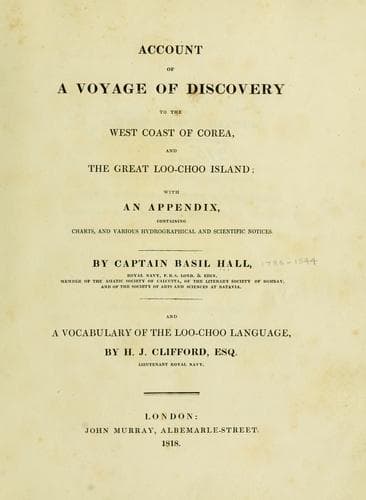
Account of a voyage of discovery to the west coast of Corea, and the great Loo-Choo IslandHall, Basil
History
Account of a voyage of discovery to the west coast of Corea, and the great Loo-Choo Island
Hall, Basil
Korea -- Description and travel; Ryukyu Islands -- Description and travel
To-day for the first time they talked unreservedly of the king, whose
name even they had hitherto studiously avoided: they spoke freely of his
majesty's having sent all the stock and vegetables with which we were
daily supplied. Captain Maxwell, who of course was very desirous of
opening a communication with the court, intimated his wish to pay his
respects as soon as might be convenient. They heard this with apparent
satisfaction, and signified that his request should be made known to the
king. We are at a loss to discover what can have caused this change of
manner. We can only conjecture, that perhaps the king, on hearing so
many reports about us, may have become desirous of seeing us himself. At
all events it is clear that some alteration in the instructions to the
chiefs must have been made, otherwise they would have shewn their usual
reserve when the king's name was mentioned, and would on no account have
allowed us to talk of visiting him.
At one o'clock we went on shore to look at the place assigned by the
chiefs for the reception of the Alceste's stores. It is an oblong
inclosure, sixty yards by forty, surrounded by a wall twelve feet high,
rather well built with squared coral: the entrance is by a large gate on
the south side, from which there extends raised gravel walks, with
clipped hedges, the intermediate spaces being laid out in beds, like a
garden. The temple in which we were feasted on the day of our first
visit, occupies one corner of the inclosure; it is completely shaded by
a grove of trees, which also overhang the wall. In that part of the
garden directly opposite to the gate, at the upper end of the walk
there is a smaller temple, nearly hid by the branches of several large
banyan trees; and before it, at the distance of ten or twelve paces, a
square awkward looking building, with a raised terrace round it. The
temple first spoken of is divided by means of shifting partitions into
four apartments, and a verandah running all round, having a row of
carved wooden pillars on its outer edge to support the roof, which
extends considerably beyond it. The floor of the verandah is two feet
from the ground, the roof is sloping and covered with handsome tiles,
those forming the eaves being ornamented with flowers and various
figures in relief; there are also several out-houses, and a kitchen
communicating with them by covered passages. In one of the inner
apartments, at the upper end, there is a small recess containing a green
shrub, in a high narrow flower-pot, having a Chinese inscription on a
tablet hanging above it on the wall. On another side of the same room,
there hangs the picture of a man rescuing a bird from the paws of a cat;
the bird seems to have been just taken from a cage, which is tumbling
over, with two other birds fluttering about in the inside: it is merely
a sketch, but is executed in a spirited manner. In one of the back
apartments we find three gilt images, eighteen inches high, with a
Public-domain text, read in full here on John Shaqi.
Reviews
Reviews
No reviews yet
Be the first to share your thoughts on this work.
Elsewhere in the archive
Join the Discussion
Join the discussion
Sign in to leave a comment or review.
Sign InorCreate an account