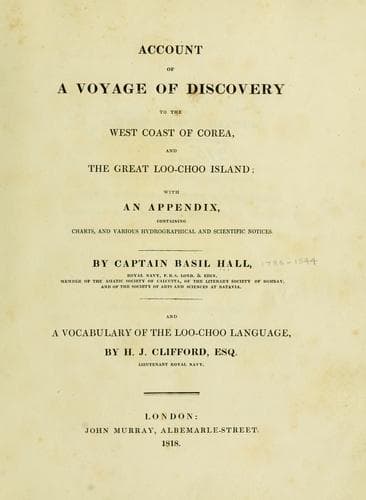
Account of a voyage of discovery to the west coast of Corea, and the great Loo-Choo IslandHall, Basil
History
Account of a voyage of discovery to the west coast of Corea, and the great Loo-Choo Island
Hall, Basil
Korea -- Description and travel; Ryukyu Islands -- Description and travel
11th of October.--In the morning we again stood in, using the
precaution of sending a boat a-head to sound the way; when we had nearly
reached the entrance we anchored, and proceeded in three boats to
examine the harbour discovered last night. As it was near noon when we
passed the small island, we landed and observed the meridian altitude of
the sun; after which we entered the harbour in the main island, by an
intricate passage of about a quarter of a mile in length, and at one
place not two hundred yards wide. Here we found ourselves in a circular
bason upwards of half a mile across, with deep water, and completely
sheltered from all winds. On its western shore we saw a large and
beautiful village almost hid amongst trees, with a high wooded range
behind it stretching to the south. The eastern shore was low and laid
out in salt fields, with a few huts here and there. At first sight this
bason did not appear to have any outlet except by the one we had
examined; but on rowing to its upper or southern side, we found that it
joined by a narrow channel with another harbour still larger, and if
possible more beautiful than the first, for here the land was high on
both sides, and richly wooded from top to bottom. Proceeding onwards
through this bason, which had all the appearance of an inland lake, we
came to another outlet, not above a hundred yards wide, formed by cliffs
rising abruptly out of the water to the height of a hundred feet. Both
sides being covered with trees, which almost met overhead, the space
below was rendered cool and pleasant, and the water, thus sheltered from
every wind, was as smooth as glass. We rowed along for some time by
various windings through this fairy scene in total uncertainty of what
was to come next, and at last, after advancing about three miles, it
opened into an extensive lake several miles in length, studded with
numerous small islands.
The depth of water in the lake varied from four to six fathoms; but in
the narrow neck which connects it with the sea the depth is from ten to
twenty fathoms, being deepest at the narrowest parts. Ships might ride
in any part of this extraordinary harbour, in perfect safety during the
most violent tempests: and the shores are so varied, that every purpose
of re-equipment might be served. At some places natural wharfs are
formed by the rocks, and eight and ten fathoms water close to them.
Ships might lie alongside these places, or might heave down by them:
there are also shallow spots on which ships might be careened. Many of
the cliffs are hollowed into caves, which would answer for storehouses;
and in the numerous lawns on both sides encampments might be formed of
any number of people.
Public-domain text, read in full here on John Shaqi.
Reviews
Reviews
No reviews yet
Be the first to share your thoughts on this work.
Elsewhere in the archive
Join the Discussion
Join the discussion
Sign in to leave a comment or review.
Sign InorCreate an account